Proudly serving Tucson, Oro Valley, Marana, Vail, Sahuarita, Green Valley & surrounding areasCall or Text 24/7: +1 (520) 567-9887

Commercial Epoxy Flooring Installation and High-Traffic Floor Systems in Tucson, AZ

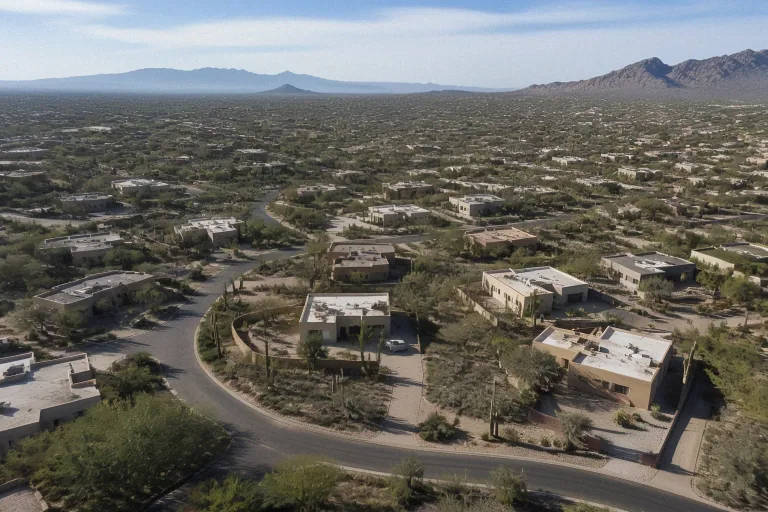
Tucson Epoxy Co. installs commercial epoxy flooring for warehouses, retail spaces, service bays, offices, and other high-traffic properties in Tucson, Arizona. We also install industrial epoxy systems, garage floor epoxy, polyaspartic coatings, and decorative flake and metallic finishes. Concrete repair and resurfacing help prepare worn or damaged slabs for a new coating. Our service area extends across Tucson and supported communities throughout Pima County.

Tucson concrete can face surface temperatures above 140 degrees, intense UV exposure, monsoon humidity, and thermal cycling. Those conditions can crack unsealed slabs, drive moisture-related failures, and discolor ordinary epoxy topcoats. We mechanically profile each slab with diamond grinding or shot blasting to the International Concrete Repair Institute surface profile required by the selected coating. Moisture-mitigating primers, 100% solids epoxy, and UV-stable polyaspartic topcoats are specified as the project requires.

Start with a free site walk-through and written estimate. We explain scope, schedule, cure time, operating-hour needs, and projected cost before work begins.

Tucson Epoxy Co. provides commercial epoxy flooring in Tucson, Oro Valley, Marana, Sahuarita, Vail, and the greater Pima County metro area.

★ ★ ★ ★ ★4.9/5 Average Rating · 20+ Years of Experience · Thousands of Customers Helped · Licensed & Insured · Residential & Commercial

Commercial Epoxy Flooring Options & Benefits

What Is Commercial Epoxy Flooring?

Commercial epoxy flooring is a bonded resin coating that creates a seamless, durable surface over prepared concrete. It helps control concrete dusting and gives maintenance teams a floor they can pressure wash and degrease without relying on bare, porous concrete.

The system is sized to the actual traffic load, so a showroom with light carts does not receive the same specification as a loading dock with daily pallet jack and forklift use. A typical assembly may combine a moisture-tested primer, high-build epoxy base, optional broadcast media, and a polyaspartic or urethane topcoat.

In Tucson, coating design must account for strong UV exposure, thermal shock, and older slabs that may lack a modern vapor barrier. Testing and product selection determine whether the floor needs moisture mitigation, extra impact resistance, slip texture, or a UV-stable finish.

Benefits of Commercial Epoxy Flooring

A correctly specified coating can make a busy concrete floor easier to maintain while matching its traffic, exposure, sanitation, and design requirements. The exact benefits depend on slab preparation and the primer, base, broadcast, and topcoat selected.

  • Abrasion resistance for carts, pallet jacks, and forklift traffic
  • Chemical resistance for oil, hydraulic fluid, battery acid, and cleaning solvents
  • A seamless surface that helps control concrete dust
  • Slip-resistant texture using broadcast aggregate or aluminum oxide grit
  • UV-stable topcoat options that resist amber discoloration
  • Build thickness tailored to foot, cart, vehicle, or industrial traffic
  • Flake, metallic, solid-color, logo, and traffic-zone design choices
  • A maintainable alternative to bare concrete, tile, or VCT
Floor Coating Services

Commercial Epoxy Flooring Services

We match coating materials and preparation methods to commercial, industrial, garage, retail, service, and outdoor concrete. These services cover new installations, decorative finishes, faster-curing topcoats, and repairs for worn Tucson slabs.

Commercial Epoxy Flooring

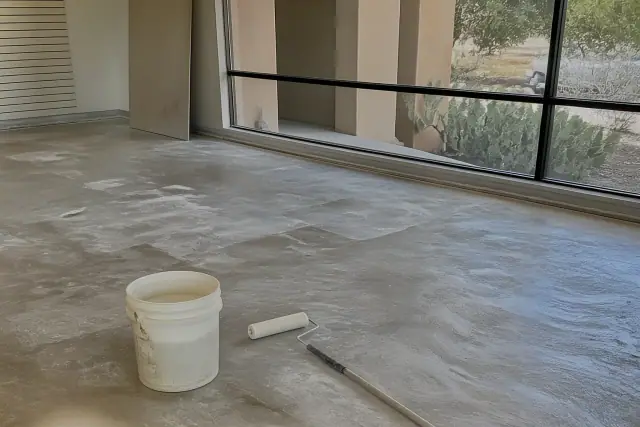
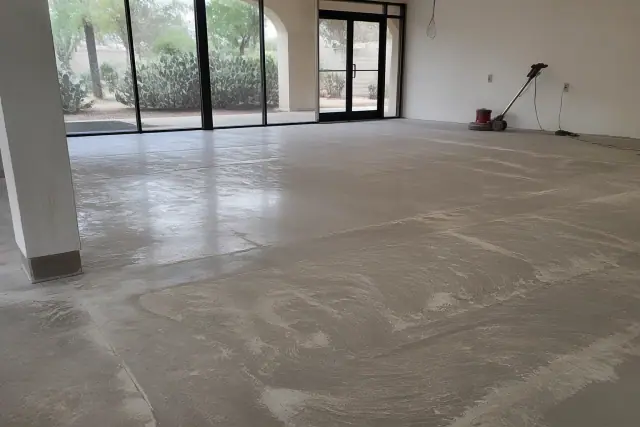
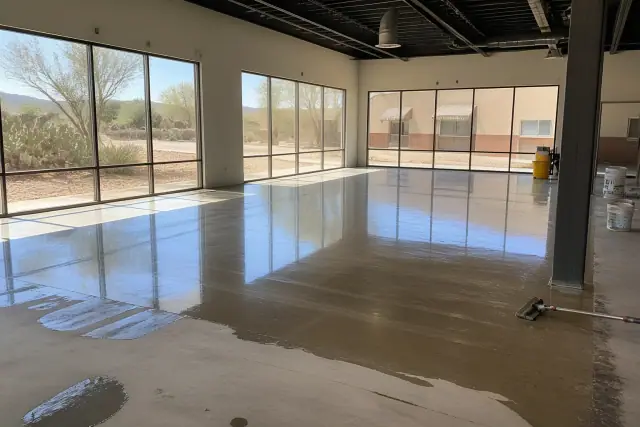
Sanded concrete retail floor prepared for epoxy installation with tools in a Tucson, AZ showroom.

We build systems for warehouses, offices, retail floors, showrooms, and service bays based on the traffic and cleaning demands each space will see. Work can be phased around operating hours for properties that cannot close completely, from warehouse space off Alvernon to retail buildouts near the Tucson Mall corridor or downtown.

Request Estimate

Industrial Epoxy Flooring

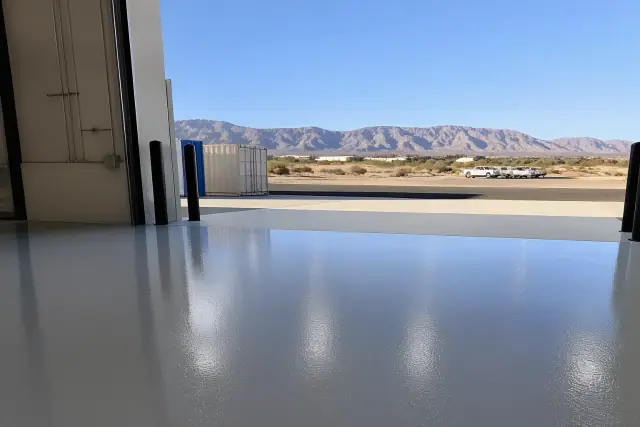
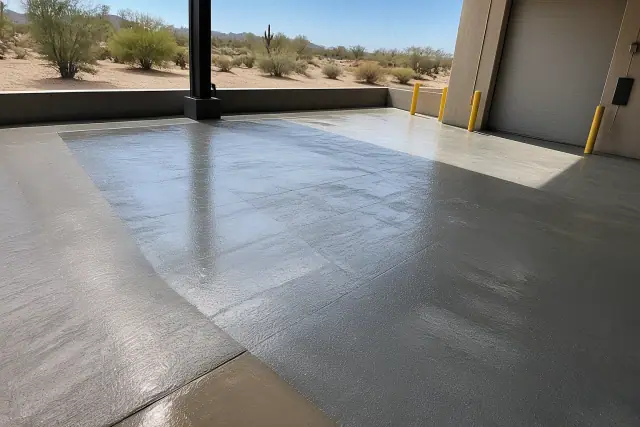
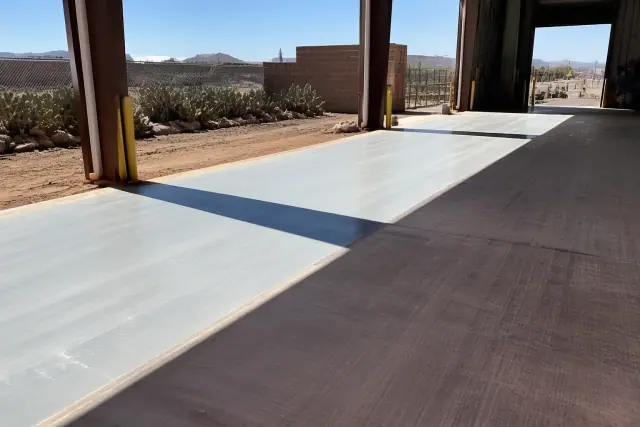
Glossy industrial epoxy flooring at a warehouse loading dock in Tucson, AZ with desert sagebrush and mountains behind.

High-build industrial coatings resist abrasion from steel-wheeled carts, pallet jacks, and forklifts in manufacturing and distribution facilities. Quartz or aluminum oxide broadcast can reinforce the surface, while urethane cement is an option where extreme thermal shock or repeated impact is part of daily work near Rita Ranch, the Port of Tucson, or the Southlands industrial park.

Request Estimate

Garage Floor Epoxy

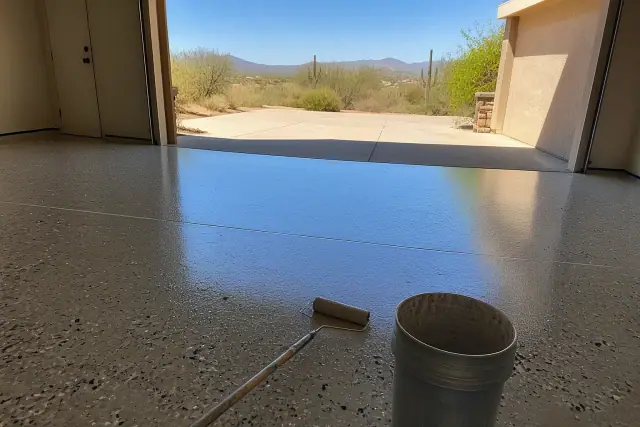
Residential garage floor with epoxy base coat and decorative flakes in Tucson, AZ, with a paint roller and bucket nearby.

Professional garage floor systems use mechanically prepared concrete and commercial-grade resin rather than relying on a thin retail kit. Solid-color, flake, or metallic finishes can be paired with a protective topcoat to resist hot tire pickup, abrasion, oil, and routine garage cleaning.

Request Estimate

Polyaspartic Floor Coatings

Sanded concrete floor in a commercial space prepared for epoxy installation in Tucson, AZ.

Polyaspartic coatings set faster than epoxy and remain UV stable under direct desert sun. We often use epoxy for structural build and self-leveling, then add a polyaspartic topcoat where quick reopening, temperature tolerance, abrasion resistance, or protection from yellowing matters.

Request Estimate

Flake and Metallic Epoxy Finishes

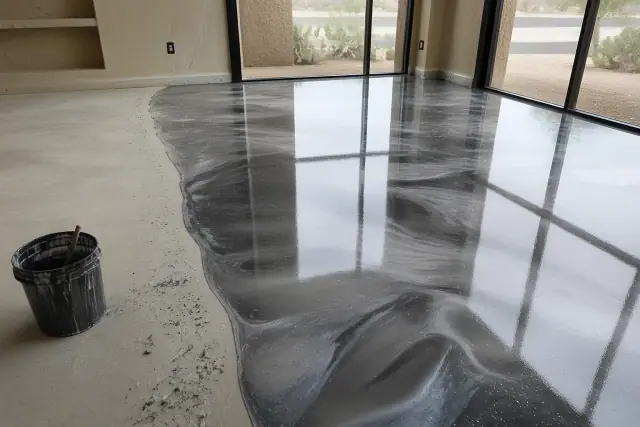
Metallic epoxy flooring installation on a concrete retail floor in Tucson, AZ with cacti visible through the window.

Flake systems use colored vinyl chips for a textured, multi-tone finish that hides dirt and scuffing, while mica-based metallic pigments create a marbled, three-dimensional appearance. Commercial clients can also incorporate brand colors, traffic-lane zones, or logo medallions into the coating design.

Request Estimate

Concrete Repair and Resurfacing

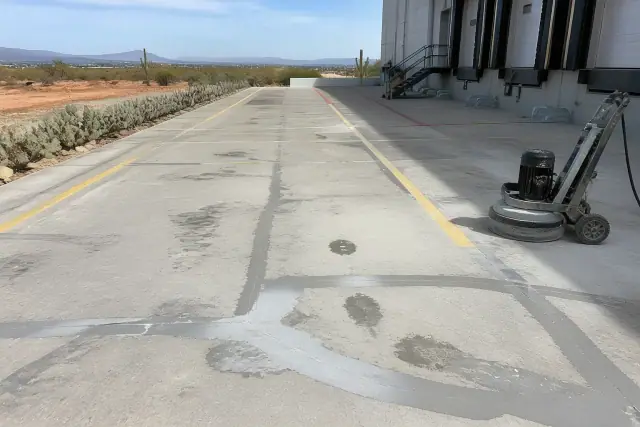
Concrete repair on a warehouse loading dock with a mechanical grinder and prickly pear cacti in Tucson, AZ.

Hairline cracks, spalls, peeling paint, and failed coatings are addressed before the new system is installed. Polymer-modified overlays or epoxy mortar can restore a workable coating surface without immediately resorting to full slab replacement, including on shop floors, patios, and pool decks selected for recoating.

Request Estimate
Coating System Options

Types of Commercial Epoxy Flooring Options

The right floor may combine several materials rather than depend on one coating alone. We select the primer, epoxy build coat, broadcast media, and topcoat around slab moisture, traffic, chemicals, sunlight, reopening time, and the finish you want.

100% solids epoxy base coat applied to a warehouse concrete floor at a loading dock in Tucson, AZ.

100% Solids Epoxy Base System

A 100% solids epoxy base provides the high-build, self-leveling layer used in many commercial and industrial systems. The complete specification is adjusted to the slab, traffic load, and exposure rather than applied as a one-size-fits-all coating.

  • Moisture-tested primer selected for the slab
  • Commercial epoxy base typically built at 20-30 mils
  • High-build resin suited to heavy traffic specifications
  • Optional broadcast media for texture and reinforcement
  • Polyaspartic or urethane topcoat selected for final exposure
Request Estimate
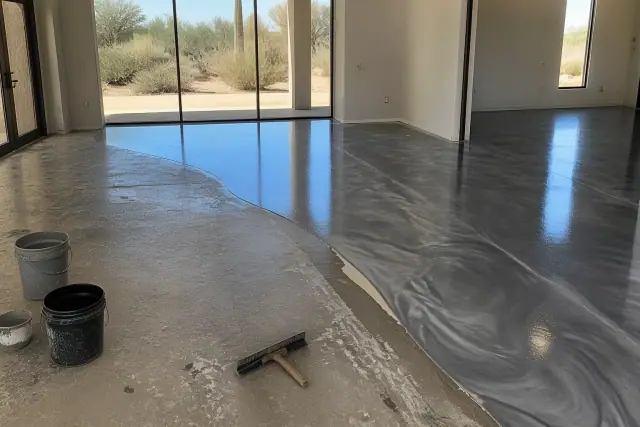
Polyaspartic topcoat curing on a commercial concrete floor in Tucson, AZ, with cacti visible through the windows.

Polyaspartic Topcoat System

A polyaspartic-based system is useful when UV stability and a shorter return-to-service window matter. Smaller commercial spaces and many garages may support same-day installation, depending on the complete system and slab condition.

  • Walkable in as little as 6 hours for qualifying systems
  • Vehicle use possible within 24 hours for qualifying systems
  • UV-stable finish that resists yellowing
  • Performance across Tucson temperature extremes
  • Fast-curing choice for tighter reopening schedules
Request Estimate
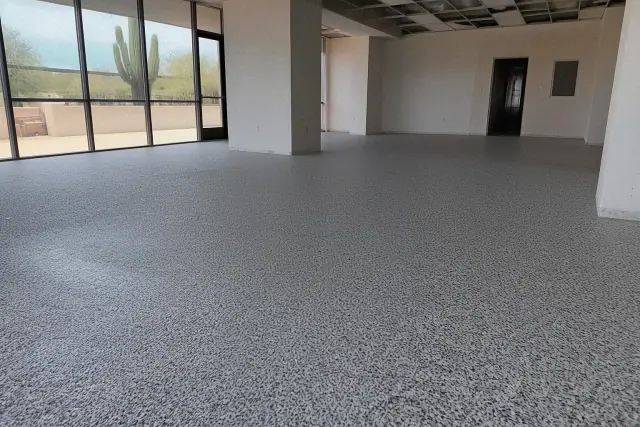
Commercial epoxy flooring with decorative flakes on a concrete floor in a Tucson, AZ shop with a cactus visible outside.

Flake Broadcast Finish

Colored vinyl chips are broadcast into the wet base coat to create a textured, multi-tone floor. Dozens of blend choices make it possible to coordinate the finish with a property while retaining a commercial-grade coating assembly.

  • Helps disguise dirt, tire marks, and minor scuffs
  • Adds texture before any topcoat aggregate is considered
  • Suitable for garages, retail spaces, and service areas
  • Supports coordinated color schemes
  • Finished with a protective clear topcoat
Request Estimate
Metallic epoxy flooring installation on a concrete floor inside a commercial space in Tucson, AZ.

Metallic Epoxy Finish

Mica-based pigments are manipulated in clear or tinted epoxy to produce depth and marbled movement. No two finished floors repeat exactly, making this option well suited to visually prominent spaces.

  • Three-dimensional marbled appearance
  • Popular for showrooms and lobbies
  • Available for high-end residential interiors
  • Compatible with color and branding direction
  • Protected by a topcoat chosen for the exposure
Request Estimate
Industrial epoxy flooring prep on a warehouse loading dock with grinding marks and prickly pear cacti in Tucson, AZ.

Heavy-Duty Industrial System

Industrial floors are built for more severe abrasion, chemical contact, impact, and thermal shock than a typical showroom or office floor. Material and build thickness are specified around the facility's actual operations.

  • High-build 100% solids epoxy
  • Quartz or aluminum oxide reinforcement
  • Formulations with compressive strength above the underlying concrete
  • Resistance to common automotive and manufacturing chemicals
  • Urethane cement option for extreme thermal shock or impact
Request Estimate
Finding Your Right Fit

Choosing the Right Commercial Epoxy Flooring Approach

A sound recommendation starts with the slab rather than a color chart. Moisture, cracking, prior coating failure, traffic, chemicals, sunlight, slip needs, sanitation requirements, operating hours, and design goals all affect the final specification.

Mechanical Surface Profiling

Diamond grinding or shot blasting opens the concrete pore structure and creates the Concrete Surface Profile required by the selected coating. This mechanical bond is more dependable for commercial resin systems than acid etching or coating over an unprepared slab.

Moisture and Slab Assessment

Every project begins with moisture testing and a visual review for cracks, spalls, oil staining, and prior coating failures. Slabs on grade without a vapor barrier may require a moisture-mitigating primer before the epoxy base is applied.

Licensed Commercial Site Work

Tucson Epoxy Co. carries the contractor licensing and general liability coverage required for commercial work in the City of Tucson and unincorporated Pima County. Installers follow the coating manufacturer's application specifications for preparation, build, recoat windows, and cure conditions.

What Sets Us Apart

Why Choose Us for Commercial Epoxy Flooring?

We control the variables that most often decide whether a floor performs: moisture testing, mechanical profiling, repairs, material selection, build thickness, recoat timing, and cure conditions. You receive a free walk-through and written estimate that explains scope, realistic scheduling, and cost before the project is placed on the calendar.

Request Free Walk-Through

Heat and UV Exposure

Direct desert sun can discolor an ordinary epoxy surface, while repeated heating and cooling add thermal stress to unsealed concrete. A UV-stable polyaspartic topcoat protects the structural epoxy base where sunlight reaches the floor.

Moisture Vapor and Monsoon Humidity

Humidity spikes during July and August can compound moisture concerns in older Tucson slabs poured without today's vapor barriers. Testing identifies whether vapor transmission needs to be addressed with a moisture-mitigating primer before the finish coats are installed.

Peeling and Delamination

Coatings can peel within the first year or two when installers skip mechanical profiling or trap an unresolved moisture issue beneath the system. Removing failed material, opening the slab, and correcting the underlying condition are essential before recoating.

Concrete Dusting, Cracks and Spalls

Heavy traffic can make bare concrete dust, spall, and shed friable surface aggregate into a warehouse or shop. Cracks and damaged areas are repaired with polymer-modified patching material, overlays, or epoxy mortar so the new coating has a sound surface.

Chemical, Abrasion and Impact Wear

Motor oil, hydraulic fluid, battery acid, cleaning solvents, steel-wheeled carts, and dropped tools place different demands on a floor. Chemical-resistant resin, reinforced broadcast media, higher build, or urethane cement can be specified around the actual exposure.

Slippery or Hard-to-Clean Floors

A smooth coating can become slick when wet unless the finish includes appropriate slip-resistant texture. Aluminum oxide grit can support walking-working surface needs, while antimicrobial additives are available for healthcare, food service, and veterinary facilities with added sanitation requirements.

How it works

Our Commercial Epoxy Flooring Process

Each floor moves through evaluation, preparation, repair, coating, and cure in a defined sequence. We set expectations for access and reopening before grinding begins, including phased scheduling when a commercial property must remain partly operational.

01.

Site Walk-Through and Written Estimate

We review the space, traffic, chemicals, finish goals, access, and operating schedule during a free walk-through. The written estimate explains the proposed scope, materials, timeline, and cost before you commit.

02.

Moisture Test and Slab Assessment

The slab is tested for moisture and inspected for cracks, spalling, oil contamination, and failed prior coatings. Those findings determine the repairs, primer, and coating build needed for the project.

03.

Diamond Grinding or Shot Blasting

Mechanical profiling removes weak surface material and opens the concrete to the International Concrete Repair Institute profile required by the selected system. Failed coatings are ground away rather than hidden beneath a new layer.

04.

Crack and Spall Repair

Cracks, spalls, and damaged areas are filled or resurfaced with a polymer-modified patching compound, overlay, or epoxy mortar suited to the condition. This creates a stable transition before the primer and base coat are installed.

05.

Primer, Base Coat and Broadcast

The primer and epoxy base are applied in sequence within manufacturer-specified recoat windows. Flake, quartz, or aluminum oxide media is broadcast when the system calls for decoration, reinforcement, or slip texture.

06.

Topcoat, Cure and Reopening

The selected polyaspartic or urethane topcoat completes the system, followed by the required cure period. Standard epoxy typically needs 24 hours before light foot traffic and about 72 hours before vehicle or heavy-equipment traffic; the exact reopening plan is confirmed for the products and site conditions used.

Start With the Slab

Plan Your Commercial
Epoxy Flooring
Estimate

Request a free walk-through for a clear recommendation based on your concrete, traffic, exposure, design goals, and reopening schedule. Tucson Epoxy Co. will provide a written estimate so you can review scope, timeline, and cost before scheduling.

Commercial Flooring Help

Commercial Epoxy Flooring FAQs

Review practical answers about Tucson epoxy flooring costs, professional materials, preparation, cure times, maintenance, and service coverage. A site walk-through is the best way to turn these general ranges into a project-specific recommendation.

Call Our Flooring Team

Commercial epoxy flooring in Tucson typically costs $3 to $12 per square foot installed. Basic high-build systems for light-traffic office or retail floors are often closer to $3 to $6 per square foot, while industrial, chemical-resistant, flake, or metallic systems trend higher. Slab condition and total square footage also affect the written estimate.

A 20x20 two-car garage is 400 square feet, and most Tucson homeowners pay between $1,600 and $4,000 for a professionally installed epoxy floor. Basic solid-color epoxy is toward the lower end, while flake or metallic finishes with a polyaspartic topcoat cost more. Crack repair, oil-stain removal, or grinding away a failed coating can add preparation cost.

Epoxy can peel when preparation or moisture control is inadequate, standard epoxy can yellow under prolonged UV exposure, and a smooth finish can be slick when wet. Mechanical profiling, moisture testing, a UV-stable polyaspartic topcoat, and slip-resistant aggregate address those project-specific risks.

Professional installers use 100% solids epoxy resin systems rather than thin, water-based retail kits. Professional-grade material cures to about 10-20 mils per coat, compared with roughly 2-3 mils for a typical DIY product. A polyaspartic topcoat may be added for UV stability, faster cure, and surface protection.

These industrial epoxy systems typically provide 10 to 20 years of service before recoating is needed. Actual life depends on traffic volume, impact, chemical exposure, maintenance, preparation quality, and whether the system was specified correctly for the space.

A properly installed floor may show light scuffing in high-traffic zones after 5 years but should not be peeling, bubbling, or delaminating. Routine cleaning and a new topcoat when the surface begins to dull can extend service life. Early widespread failure usually points to preparation or moisture problems.

Arizona requires appropriate contractor licensing for flooring and concrete-coating work above the state's minimum threshold. Tucson Epoxy Co. carries the contractor licensing and general liability coverage required for its commercial and residential installation work in Pima County. Property owners can confirm a contractor's status through the Arizona Registrar of Contractors.

Epoxy offers strong build thickness and self-leveling properties, making it useful as a structural base coat. Polyaspartic material sets in hours rather than days and remains UV stable, so it works well as a fast-curing topcoat under Tucson sun. Many systems combine both materials.

The timeline depends on the coating system, temperature, and manufacturer-specified cure window. Traditional epoxy takes longer than a polyaspartic-based system, so the exact foot-traffic, vehicle, and heavy-equipment schedule is reviewed before work starts. Phased scheduling may help a business that cannot close the entire space at once.

Preparation begins with moisture testing and an inspection for cracks, spalls, contamination, and failed coatings. The slab is diamond ground or shot blasted to the required Concrete Surface Profile, then damaged areas are repaired before primer is applied. Acid etching does not replace the mechanical profiling used for these commercial systems.

Yes. Slip-resistant texture can be built with flake, broadcast media, or aluminum oxide grit selected for the space. The texture should balance traction with cleaning needs, particularly in service bays, food service, healthcare, and other areas exposed to liquids.

Coverage varies by the coating system and application selected for the project. Tucson Epoxy Co. reviews the specific terms before installation rather than presenting one warranty as if it applies to every floor. Proper moisture testing, profiling, build thickness, and cure conditions remain important to long-term performance.

Tucson Epoxy Co. serves Tucson, Oro Valley, Marana, Sahuarita, Vail, and the greater Pima County metro area. Project types include warehouses, manufacturing floors, retail spaces, offices, service bays, showrooms, garages, patios, and pool decks.