Proudly serving Tucson, Oro Valley, Marana, Vail, Sahuarita, Green Valley & surrounding areasCall or Text 24/7: +1 (520) 567-9887

Concrete Floor Coatings, Resurfacing, and Installation Services in Tucson, AZ

Tucson Epoxy Co. installs concrete floor coatings throughout Tucson, Arizona, for garages, homes, retail spaces, warehouses, patios, and pool decks. Our services include garage floor epoxy, polyaspartic coatings, commercial and industrial epoxy flooring, decorative flake and metallic finishes, and concrete repair resurfacing. We match each coating system to the slab's traffic load, chemical exposure, and sunlight. The result is a sealed surface designed around how the space is actually used.

Tucson slabs face summer surface temperatures above 140 degrees, monsoon moisture, caliche dust, and heat-driven expansion. Those conditions can contribute to cracks, pitting, stains, hot tire pickup, and early delamination when preparation or product selection is wrong. We begin with a diagnostic inspection and mechanical surface profiling, then choose moisture-mitigating primers, slip-resistant aggregates, and UV-stable topcoats as needed. Our crews follow preparation practices consistent with ICRI guidance and hold licensing through the Arizona Registrar of Contractors.

Call for a slab assessment and written scope before choosing an epoxy or polyaspartic system.

Tucson Epoxy Co. installs concrete floor coatings in Tucson and the surrounding metro area, including Oro Valley, Marana, Sahuarita, Vail, Green Valley, and Catalina Foothills.

★ ★ ★ ★ ★4.9/5 Average Rating · 20+ Years of Experience · Thousands of Customers Helped · Licensed & Insured · Residential & Commercial

Concrete Floor Coating Benefits

What Are Concrete Floor Coatings?

Bare concrete is porous, so it absorbs oil, tire residue, chemicals, and monsoon moisture. Epoxy and polyaspartic coatings seal that porosity with a continuous surface that is easier to clean and better able to resist stains.

A coating system may combine a moisture-mitigating primer, epoxy base coat, decorative or slip-resistant broadcast, and a polyurethane or polyaspartic topcoat. The layers are selected for the slab's moisture condition, sunlight, traffic, and chemical exposure.

Residential floors can prioritize color and everyday cleanup, while commercial and industrial floors may require higher film thickness, impact resistance, or anti-slip additives. Proper mechanical preparation is what gives each system a sound surface to bond to.

Benefits of Concrete Floor Coatings

A correctly specified coating changes bare concrete into a sealed, serviceable finish. Depending on the system and space, that can improve stain resistance, traction, appearance, UV stability, and long-term maintenance.

  • Seals porous concrete against oil, tire residue, and monsoon moisture
  • Resists battery acid drips, pool chemicals, and other chemical exposure
  • Supports vehicle loads, foot traffic, carts, and rolling tool chests
  • Uses UV-stable topcoats where direct Tucson sunlight threatens color stability
  • Adds slip-resistant aggregate for wet or high-traffic areas
  • Creates a continuous finish that cleans more easily than bare concrete
  • Offers flake, metallic, stained, and custom decorative looks
  • Can hold up 10 to 20 years before recoating when correctly prepared and installed
Coatings for Every Space

Concrete Floor Coating Services

We build residential, commercial, industrial, decorative, and outdoor coating systems around the demands of each slab. Surface condition, traffic, chemical contact, sun exposure, moisture, and desired finish all shape the recommendation.

Garage Floor Epoxy

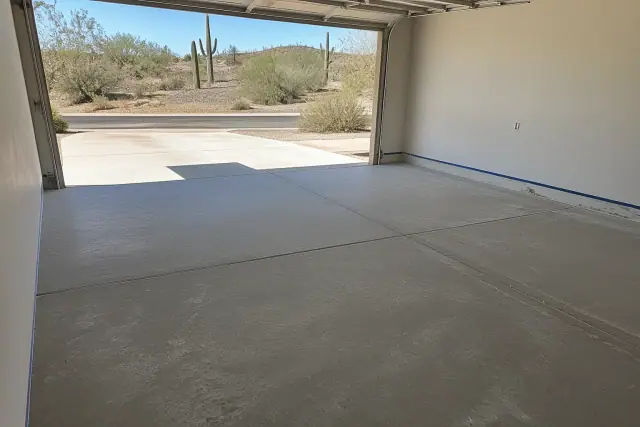
Empty two-car residential garage with a concrete floor prepped for epoxy coating in Tucson, AZ.

Garage systems are designed for vehicle loads, foot traffic, rolling tool chests, oil, and transmission fluid, which untreated concrete can absorb permanently within hours. Diamond grinding and a properly cured build help prevent hot tires from lifting a poorly bonded coating.

Request Estimate

Residential Concrete Coatings

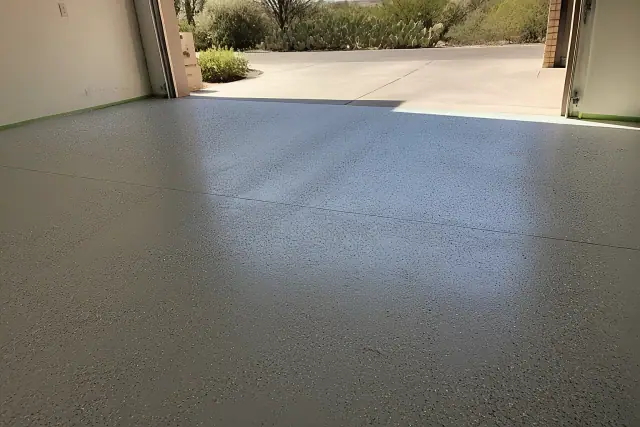
Concrete garage floor with base coat and flakes in a residential home in Tucson, AZ.

Kitchen, basement, utility-room, and other residential floors can combine stain resistance with decorative color and finish choices. We match the coating and texture to how the room is used and to the home's existing surfaces.

Request Estimate

Commercial Epoxy Flooring

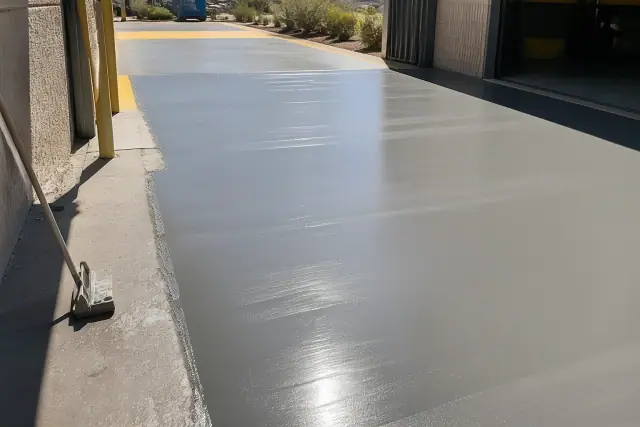
Epoxy floor coating being applied to a warehouse loading dock in Tucson, AZ, with desert brush visible outside.

Retail floors, showrooms, offices, and hospitality spaces around downtown Tucson and the University of Arizona corridor need finishes that clean easily and withstand daily foot and cart traffic. Traffic-rated systems help protect entryways while decorative options keep the floor sharp under commercial lighting.

Request Estimate

Industrial Epoxy Flooring

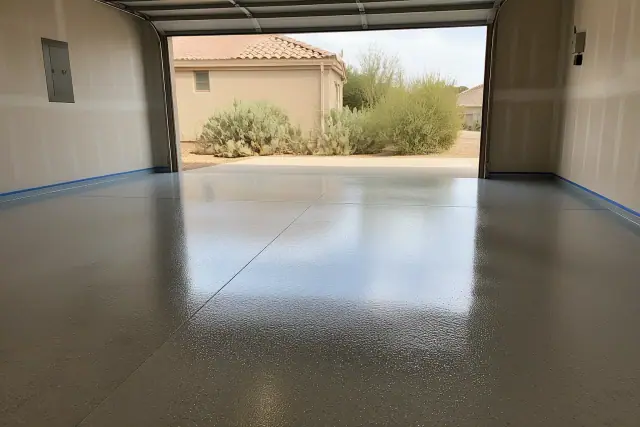
Empty residential garage with a new epoxy floor in Tucson, AZ, showing desert landscaping through the open door.

Warehouse and manufacturing floors can require higher-mil broadcast or trowel systems for forklift traffic, palletized loads, chemical spills, and loading-dock thermal shock. Quartz or aluminum oxide additives can increase traction and impact resistance.

Request Estimate

Patio and Pool Deck Coatings

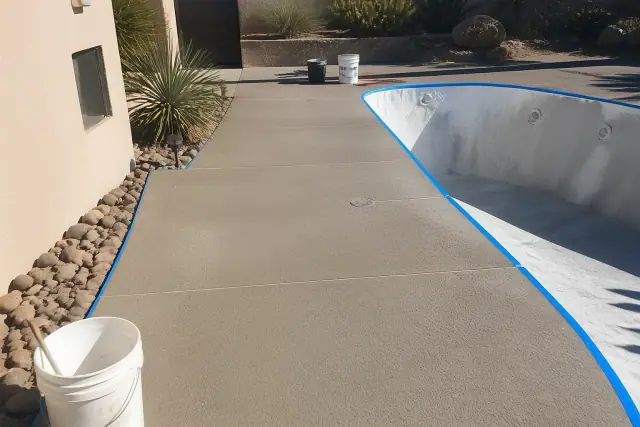
Concrete pool deck walkway during a coating project in Tucson, AZ with tools and masking tape visible.

Patios and pool decks need water resistance, slip-resistant texture, and stronger color stability under direct sun. Polyaspartic topcoats are our default recommendation for these outdoor surfaces because standard epoxy can amber under UV exposure.

Request Estimate

Concrete Repair and Resurfacing

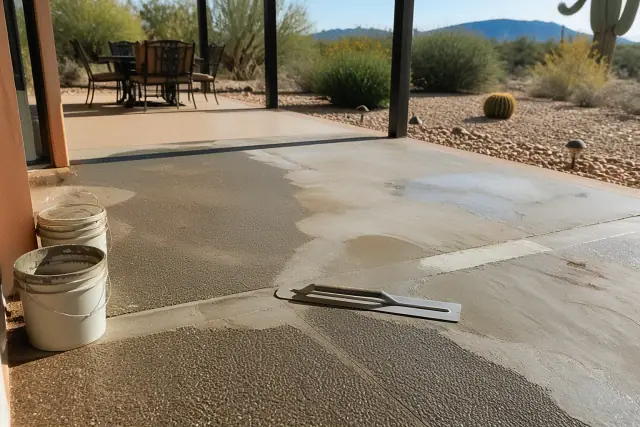
Concrete patio undergoing structural repair and surface leveling in a Tucson, AZ backyard.

Cracks may be treated with semi-rigid epoxy or polyurea injection, while widespread pitting, scaling, or stubborn old paint may call for a polymer-modified or cementitious overlay. Resurfacing creates a sound substrate instead of coating over multiple weak points.

Request Estimate
Coating System Options

Types of Concrete Floor Coating Systems

Epoxy, flake, polyaspartic, metallic, and industrial builds differ in appearance, film thickness, UV stability, cure time, and price. These typical Tucson ranges help frame the options, while a slab assessment determines the actual scope.

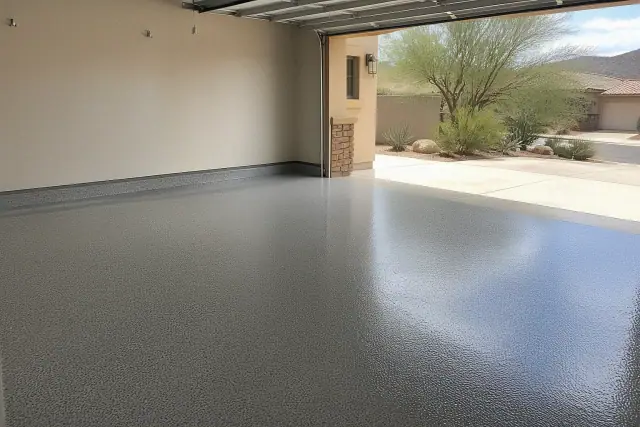
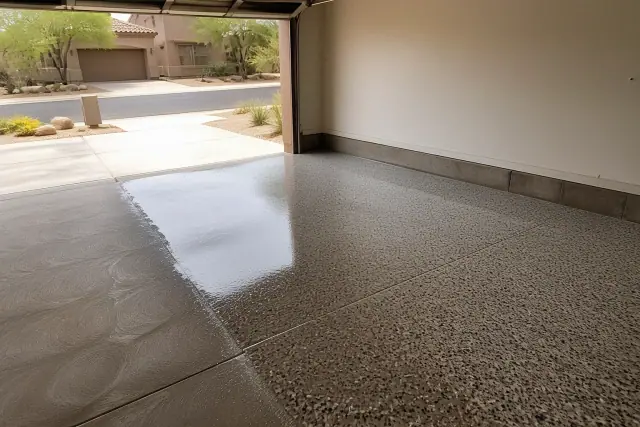
High-gloss epoxy concrete garage floor in a Tucson, AZ residence with views of prickly pear cactus outside.

Standard Epoxy

A standard epoxy build provides a strong, chemical-resistant base for garages, patios, and other concrete surfaces. It is especially useful where direct UV exposure is limited or a UV-stable topcoat can be added.

  • Typical cost: $3-$7 per square foot
  • Typical cure time: 3-7 days
  • Common fit: garages and patios
  • Available as a 100% solids epoxy base coat
  • Resists oil, chemicals, and everyday traffic
Request Estimate
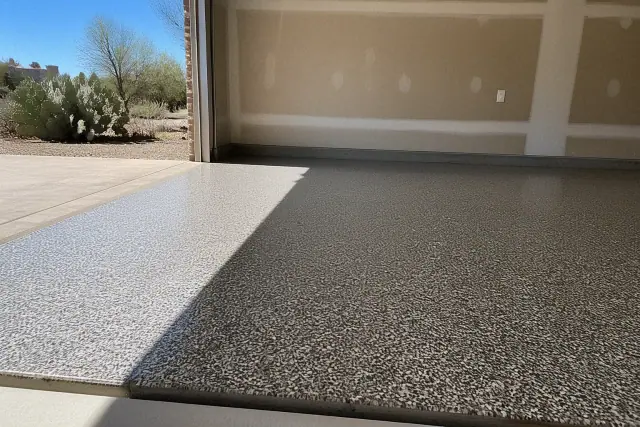
Epoxy flake concrete floor installation in a two-car residential garage in Tucson, AZ.

Flake Epoxy

A decorative flake broadcast adds color variation, texture, and visual coverage over the epoxy base. A polyaspartic or polyurethane topcoat seals the broadcast for garage and retail use.

  • Typical cost: $5-$9 per square foot
  • Typical cure time: 3-5 days
  • Common fit: garages and retail floors
  • Broadcast texture helps disguise minor visual variation
  • Can pair with a UV-stable protective topcoat
Request Estimate
Polyaspartic floor coating with decorative flakes being applied to a residential garage concrete floor in Tucson, AZ.

Polyaspartic Coatings

Polyaspartic resins cure faster than traditional epoxy and retain color and gloss longer under direct UV exposure. They work well where Tucson heat, sunlight, or limited shutdown time shapes the project.

  • Typical cost: $6-$12 per square foot
  • Typical cure time: 1-3 days
  • Can often be walked on in as little as 24 hours
  • May support vehicle traffic within a few days
  • Common fit: fast-turnaround and UV-exposed floors
Request Estimate
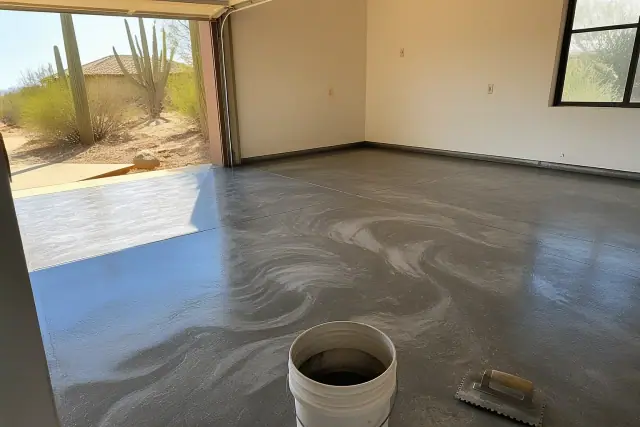
Metallic epoxy floor with a swirling marble design in a Tucson, AZ residential garage with saguaro cacti in the background.

Metallic Epoxy

Metallic floors suspend mica pigments in clear epoxy, then manipulate them while wet to create depth and movement. Copper and rust can echo the Santa Catalina Mountains, while cool blues recall a monsoon sky and can coordinate with interior tile or business colors.

  • Typical cost: $8-$15 per square foot
  • Typical cure time: 3-5 days
  • Common fit: showrooms and feature floors
  • Mica pigments create a three-dimensional visual effect
  • A high-build topcoat adds gloss, depth, and UV protection
Request Estimate
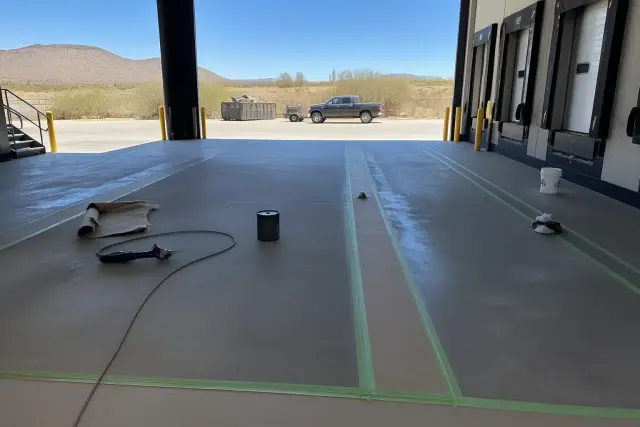
Industrial floor systems being prepped on a concrete loading dock at a warehouse in Tucson, AZ.

Industrial Systems

Industrial builds use greater film thickness and may include broadcast or trowel application for demanding facilities. The specification can address forklift scuffing, palletized loads, chemical drips, impact, and thermal shock.

  • Typical cost: $7-$15 per square foot
  • Typical cure time: 5-7 days
  • Common fit: warehouses and manufacturing plants
  • Higher-mil systems handle heavier traffic and chemical exposure
  • Quartz or aluminum oxide can improve slip resistance
Request Estimate
Finding Your Right Fit

Choosing the Right Coating Approach

Choosing among epoxy, polyaspartic, flake, metallic, and industrial builds starts with traffic, chemical exposure, UV, moisture results, and slab condition. A properly prepared coating expected to last 10 to 20 years can be a better long-term fit than resealing bare concrete every 2 to 3 years. Nationally, the concrete flooring market has grown at roughly a 4.1% compound annual rate, but the right Tucson system still comes down to the individual slab and its use.

Diagnostic Slab Preparation

Every project begins by checking the slab for cracks, spalling, moisture intrusion, oil, sealers, and old coatings. We mechanically diamond-grind rather than rely on acid etching, which cannot reliably remove oil, laitance, or existing sealers.

Desert-Ready System Selection

We select primers, base coats, aggregates, and topcoats for Tucson conditions that include 115-degree pavement heat and monsoon flash flooding. Moisture mitigation, UV stability, and traction are specified where the slab and use call for them.

Standards-Based Work

Our preparation follows practices consistent with ICRI guidance, and moisture testing uses ASTM F1869 where applicable. Tucson Epoxy Co. holds licensing through the Arizona Registrar of Contractors and provides a written scope after assessing the slab.

Avoid Early Coating Failure

Common Concrete Coating Problems

Peeling, bubbling, yellowing, soft spots, and cracking are often signs that the slab, product, or cure schedule was not handled correctly. Diagnosing the cause before recoating helps avoid covering a failure point with another layer.

Request Slab Assessment

Peeling and Delamination

Coatings can peel or bubble when they are applied over dust, laitance, oil, sealers, or a slab without the right mechanical profile. Skipping the grind step is the leading cause of early delamination we see on Tucson garage floors.

Moisture-Driven Failure

Monsoon runoff can push moisture vapor through a slab and break the coating bond. Testing before installation identifies whether a moisture-mitigating primer or a different approach is needed.

Hot Tire Pickup

Hot tires can soften standard sealers or lift under-cured, poorly bonded coatings. A mechanically prepared surface, compatible system, and complete cure schedule reduce that risk in Tucson garages.

UV Yellowing

Standard epoxy can amber or yellow under direct sunlight, sometimes within the first year. West-facing garages, patios, sunrooms, and pool decks benefit from a UV-stable topcoat selected for prolonged exposure.

Cracks, Pitting, and Spalling

Heat-driven expansion, expansive clay, and caliche subgrade can contribute to movement and surface damage. Untreated Tucson concrete commonly develops pitting, dusting, or hairline cracks within 5 to 10 years, so damage must be repaired or resurfaced before coating.

Soft or Tacky Coatings

Improper mix ratios and amine blush can leave an epoxy surface soft, tacky, or uneven. Accurate mixing, temperature-aware working time, and an unrushed cure schedule help prevent these installation defects.

How It Works

Our Concrete Floor Coating Process

A durable coating depends on the work beneath the finish. Our process moves from diagnosis and moisture testing through mechanical preparation, repairs, coating application, and a system-specific cure window.

01.

Inspect the Slab

We inspect for structural cracking, spalling, moisture intrusion, oil, old coatings, and other bond risks. The space's traffic, chemical exposure, and sunlight are documented in the written scope.

02.

Test for Moisture

Moisture testing follows ASTM F1869 to confirm vapor emission is under 3 lbs per 1,000 square feet per 24 hours before coating. Results determine whether moisture mitigation is needed.

03.

Diamond-Grind the Surface

Mechanical diamond grinding creates an ICRI CSP 3 profile and removes laitance, embedded oil, sealers, and old coatings. Acid etching alone cannot do that reliably.

04.

Repair and Resurface

Cracks are repaired before coating, and widespread pitting or scaling may receive a polymer-modified or cementitious overlay. This creates a sound substrate instead of leaving failure points beneath the finish.

05.

Apply the Coating Build

The specified primer and 100% solids epoxy base coat are applied, followed by an optional flake, quartz, or aluminum oxide broadcast. Film thickness and additives follow the space's traffic and exposure requirements.

06.

Topcoat and Cure

A polyaspartic or polyurethane topcoat seals the finished system and adds the specified UV or wear protection. We set the return-to-service schedule by coating chemistry, since some epoxy systems need a full week while faster polyaspartic builds can support earlier use.

Plan Your Floor

Schedule a Concrete Floor
Coating
Assessment

Tell us how the space is used and what condition the slab is in. Tucson Epoxy Co. will assess the surface and provide a written scope for the recommended coating build.

Concrete Coating Help

Concrete Floor Coating FAQs

These answers cover Tucson coating costs, system selection, preparation, cure time, repairs, and service areas. Call if you need a recommendation based on your slab's condition and use.

Call Our Experts

Most residential concrete floor coatings in Tucson run from $3 to $12 per square foot, while the full range across standard, decorative, and industrial systems is generally $3 to $15 per square foot installed. A two-car garage may run a few thousand dollars for a standard flake system, while a large commercial floor costs more because of material volume and preparation labor. Slab condition, crack repair, resurfacing, oil removal, moisture mitigation, and system selection affect the final price. We provide a written scope after inspecting the slab.

Standard epoxy without UV protection can amber or yellow in direct sunlight, and it typically cures more slowly than polyaspartic. Poor preparation can also lead to delamination. We address those limitations with mechanical profiling, complete cure schedules, and UV-stable topcoats where the floor receives direct sun.

Common failures include peeling, bubbling, hot tire pickup, moisture-related delamination, yellowing, and soft or tacky spots. They usually trace to poor surface preparation, untested moisture, incorrect mix ratios, or rushed cure schedules. Diagnosing the cause before recoating is essential.

There is no single best coating for every slab. UV-exposed garages and patios often benefit from polyaspartic topcoats, while warehouses may need higher-mil epoxy with anti-slip additives. The right choice depends on traffic, chemicals, sunlight, moisture, and slab condition.

Without a mechanical profile, epoxy may sit on laitance, dust, oil, old sealers, or paint instead of bonding to sound concrete. That weak bond can peel under hot tires or traffic within months. Diamond grinding to an ICRI CSP 3 profile removes bond breakers and gives the coating a surface it can mechanically key into.

Polyaspartic offers faster curing and better color stability under UV exposure, which helps on sunlit Tucson floors. Epoxy remains useful for its chemical resistance and value in spaces with limited direct sunlight. Many projects combine an epoxy base for strength with a polyaspartic topcoat for UV stability and faster return to service.

A correctly prepared and installed system typically holds up 10 to 20 years before recoating is needed. Actual life depends on traffic, chemical exposure, sunlight, maintenance, and whether moisture or slab damage was addressed before installation.

Polyaspartic coatings can often be walked on in as little as 24 hours and may support vehicle traffic within a few days. Some epoxy systems require a full week of cure time. Temperature, coating chemistry, and the complete system build determine the actual schedule.

Many damaged slabs can be coated after the underlying problems are repaired. Cracks may receive semi-rigid epoxy or polyurea treatment, while widespread pitting, scaling, or stubborn old paint may call for resurfacing with a polymer-modified or cementitious overlay. We inspect for structural cracking and moisture before recommending a build.

Commercial floors need a traffic rating suited to foot and cart use, while warehouses may require higher film thickness for forklifts, palletized loads, impacts, and chemical spills. Quartz or aluminum oxide can add traction. Kitchens and medical facilities may also need antimicrobial additives, coved bases, and transitions designed for sanitation standards enforced by the Pima County Health Department.

Outdoor surfaces need water resistance, slip-resistant texture, and color stability under Tucson sunlight. A polyaspartic topcoat helps protect against UV yellowing, while the aggregate blend is selected for traction around wet areas. Pool deck systems should also be chosen with underfoot comfort in mind.

Mica pigments are suspended in a clear epoxy base and manipulated with brushes and forced air while the material is wet. That movement creates depth and a three-dimensional look. A high-build polyaspartic topcoat can add gloss and UV protection for feature floors that receive direct light.

Tucson Epoxy Co. serves Tucson and the surrounding metro area. Named service areas include Oro Valley, Marana, Sahuarita, Vail, Green Valley, and Catalina Foothills.