Proudly serving Tucson, Oro Valley, Marana, Vail, Sahuarita, Green Valley & surrounding areasCall or Text 24/7: +1 (520) 567-9887

Garage Floor Epoxy Installation and Concrete Coating Systems in Tucson, AZ

Tucson Epoxy Co. installs garage floor epoxy and concrete floor coatings throughout the Tucson metro area. Our residential options include traditional epoxy, fast-curing polyaspartic coatings, decorative flake floors, and custom metallic finishes. We also install commercial and industrial epoxy flooring and coat patios and pool decks after completing any needed concrete repair or resurfacing.

Tucson pavement temperatures regularly rise above 150 degrees, while desert soil movement and cool winter nights make concrete expand, contract, crack, and dust. We mechanically grind each slab, repair damaged areas, and test for moisture before applying the coating system. Industrial-grade resins, anti-skid additives, UV-resistant topcoats, and chemical-resistant formulations help the finished floor handle local heat, sun, vehicle traffic, and workshop spills. Our licensed and insured flooring crew follows manufacturer specifications for cure temperature and humidity.

Call Tucson Epoxy Co. for a straightforward, no-pressure quote based on your slab condition, finish, and intended use.

Tucson Epoxy Co. installs garage floor epoxy throughout Tucson, Oro Valley, Marana, Sahuarita, and the greater Pima County metro area.

★ ★ ★ ★ ★4.9/5 Average Rating · 20+ Years of Experience · Thousands of Customers Helped · Licensed & Insured · Residential & Commercial

Garage Floor Coating Options & Benefits

What Is Garage Floor Epoxy?

A professional garage floor system bonds resin coatings to prepared concrete rather than simply painting the surface. A typical build can include a penetrating primer, epoxy base coat, decorative color or flake layer, and a clear epoxy, polyurethane, or polyaspartic topcoat.

The layered finish helps seal dusting concrete and resist stains, abrasion, and chemical exposure. UV-resistant topcoats and anti-skid additives address two practical Tucson concerns: intense light entering an open garage and glossy floors becoming slick when wet.

System selection depends on how the space is used, how quickly it must return to service, the slab's moisture and repair needs, and the desired appearance. The right preparation and cure schedule are as important as the resin selected.

Benefits of Professional Garage Floor Coatings

A properly prepared epoxy or polyaspartic system turns porous concrete into a more durable, easier-to-clean surface. With normal residential use, a quality system is engineered to last 10 to 20 years, while decorative choices can make the garage feel more like a finished room.

  • Seals concrete dust and porous surfaces
  • Resists motor oil, gasoline, brake fluid, and pool chemicals
  • Handles vehicle traffic, tool drops, and everyday abrasion
  • Offers UV-resistant topcoats for open-garage sun exposure
  • Adds traction with aluminum oxide or polymer grit
  • Hides dirt and tire marks with decorative flake blends
  • Creates custom marbled effects with mica-based metallic pigments
  • Reduces routine care to occasional mopping
Garage Floor Coating Services

Epoxy Flooring Services

We prepare and coat residential, commercial, industrial, and outdoor concrete surfaces according to their traffic, exposure, and finish requirements. Our crews work on Tucson-area slabs poured in the 1970s as well as recent construction, adjusting repairs and preparation to the concrete in front of us.

Residential Garage Floor Epoxy

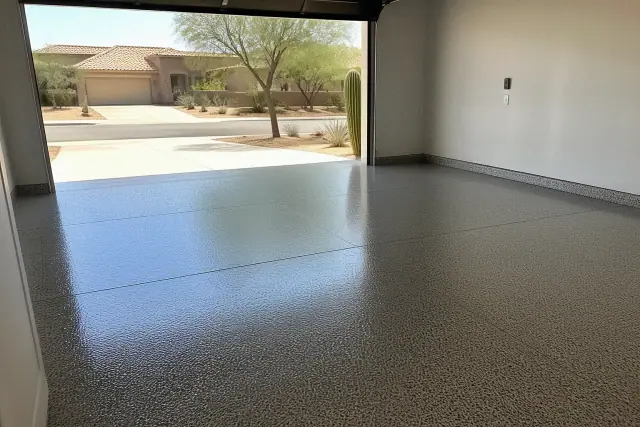
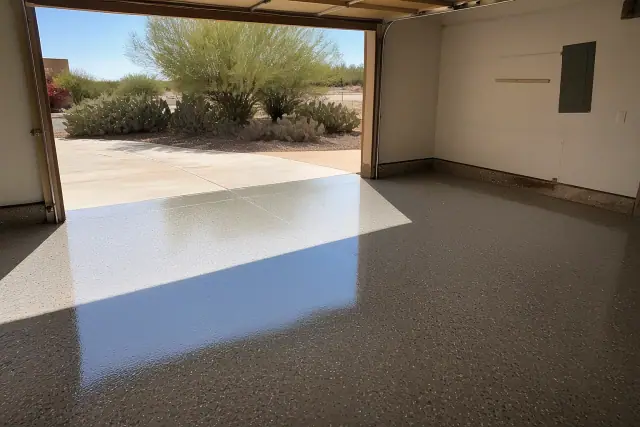
Empty two-car residential garage in Tucson, AZ with a freshly cured, high-gloss decorative flake epoxy floor.

Residential systems for one-, two-, and three-car garages can combine a base coat, decorative flake or color layer, and clear urethane or polyaspartic topcoat. The finished floor is designed for vehicle traffic, tool drops, stains, and hot tires without sacrificing easy cleanup.

Request Estimate

Commercial Epoxy Flooring

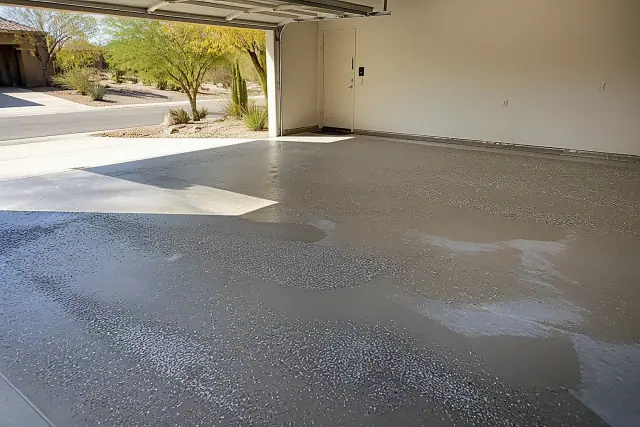
Empty two-car garage in Tucson, AZ with concrete floor prepped for epoxy coating and decorative flakes.

Retail showrooms, auto dealerships, and office buildings need floors that look clean under bright lighting and withstand foot traffic and rolling carts. Higher-mil-thickness base coats, low-odor options, and slip-resistant additives can be specified to suit the space and Occupational Safety and Health Administration walkway guidance.

Request Estimate

Industrial Epoxy Coatings

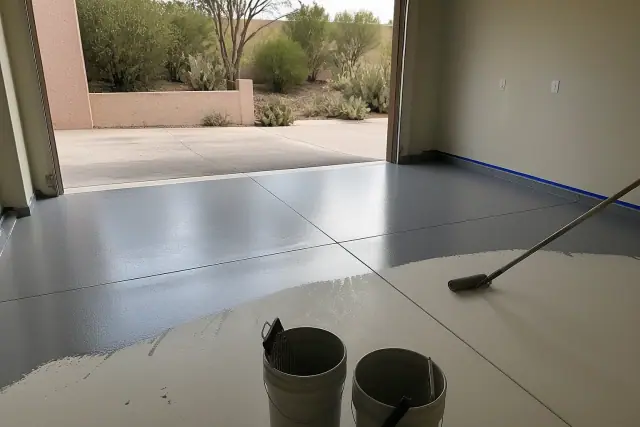
Residential garage floor prepped for industrial epoxy coating in Tucson, AZ with mixing buckets and tools.

Heavy-duty systems for warehouses, manufacturing floors, and distribution centers resist oil, solvents, abrasion, forklifts, and pallet jacks. Static-dissipative properties can also be specified for facilities that handle sensitive electronics or combustible materials.

Request Estimate

Concrete Repair and Resurfacing

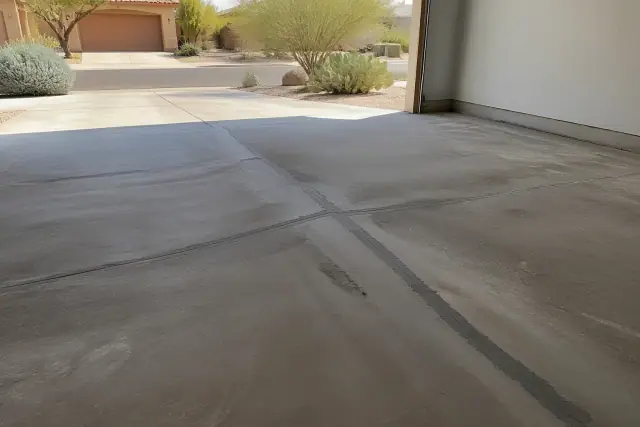
Prepped two-car garage concrete floor with crack repairs and desert landscape view in Tucson, AZ.

Cracks, pitting, and spalled areas must be corrected before a coating can bond reliably. We mechanically remove weak material and use polymer-modified patching compounds to create a sound surface before priming and coating.

Request Estimate

Patio Floor Coatings

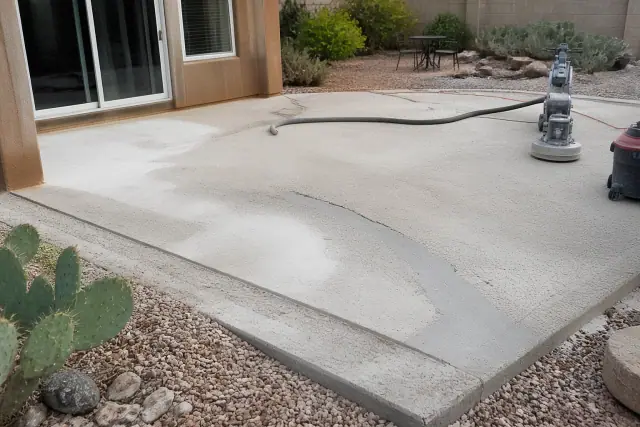
Concrete patio floor undergoing structural repair and surface grinding in a Tucson, AZ backyard with desert landscaping.

Patio coatings extend durable color and easier cleaning to outdoor living areas. UV-resistant finishes, decorative blends, and anti-skid texture can coordinate with a garage while addressing direct sun and occasional water.

Request Estimate

Pool Deck Coatings

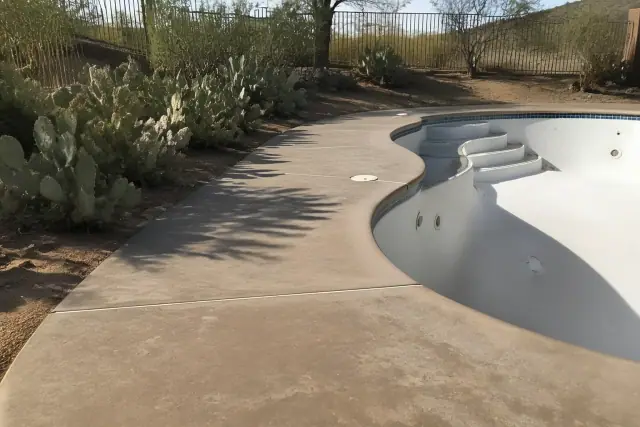
Pool deck coating project on a drained swimming pool surrounded by prickly pear cacti in Tucson, AZ.

Pool deck coatings combine a coordinated decorative finish with texture that improves traction underfoot. We recommend an anti-skid addition because a smooth glossy coating becomes noticeably slick when exposed to splashed pool water.

Request Estimate
Garage Floor Coating Options

Types of Garage Floor Coating Options

Epoxy, polyaspartic, hybrid, metallic, and flake systems each balance installation time, appearance, UV exposure, chemical resistance, and budget differently. We compare those factors with slab condition and daily use before recommending a build.

Glossy epoxy floor with decorative flakes in an empty two-car residential garage in Tucson, AZ.

Traditional Epoxy Systems

Traditional epoxy creates a thick, bonded coating with strong color, stain, and chemical resistance. Premium installations can use 100% solids epoxy at commercial-grade thickness, with the final cure schedule based on the exact resin and site conditions.

  • Concrete-penetrating primer
  • Controlled-mil base-coat application
  • Solid, flake, or metallic color layer
  • Clear epoxy, polyurethane, or polyaspartic topcoat
  • Standard epoxy cure schedule of about 24 hours for light foot traffic
Request Estimate
Freshly applied polyaspartic garage floor coating with decorative flakes in a Tucson, AZ home.

Polyaspartic Coatings

Polyaspartic coatings cure faster and resist UV fading, yellowing, chemicals, and hot tire pickup better than standard epoxy. That combination is valuable in a city with over 280 sunny days a year and during humid monsoon periods.

  • Foot traffic may be possible within hours
  • Vehicle traffic may be possible within 24 to 48 hours
  • Select projects can offer same-day turnaround for foot traffic
  • Improved resistance to amine blush
  • Flexible, hard-wearing finish for workshop garages
Request Estimate
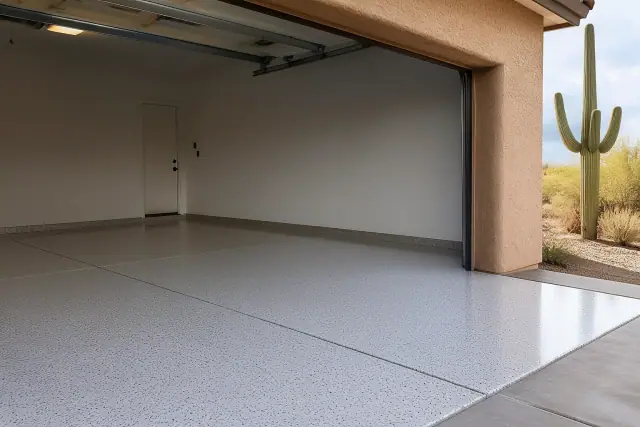
Glossy decorative flake garage floor in a Tucson, AZ home with a view of a Saguaro cactus through the open door.

Hybrid Epoxy-Polyaspartic Systems

A hybrid system pairs an epoxy base coat with a polyaspartic topcoat. It combines epoxy's cost efficiency and build thickness with added UV, chemical, and hot-tire resistance at the exposed surface.

  • Epoxy base for strong concrete adhesion
  • Polyaspartic topcoat for UV resistance
  • Better defense against hot tire pickup
  • Compatible with flake or color layers
  • Balanced choice for budget, finish, and durability
Request Estimate
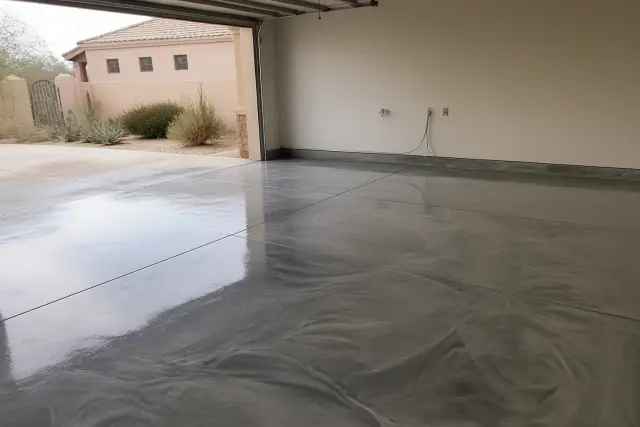
Glossy metallic epoxy garage floor with a desert view of cacti and stucco homes in Tucson, AZ.

Metallic Epoxy Flooring

Metallic epoxy suspends mica-based pigments in clear resin, then uses brushes, blowers, and squeegees to form layered marbled patterns. The movement of the material makes every square foot different, creating a custom finish for garages, patios, or showrooms.

  • Three-dimensional marbled appearance
  • Mica-based pigments suspended in resin
  • Patterns shaped with brushes, blowers, and squeegees
  • Solid, blended, and custom color combinations
  • Distinct finish across every part of the floor
Request Estimate
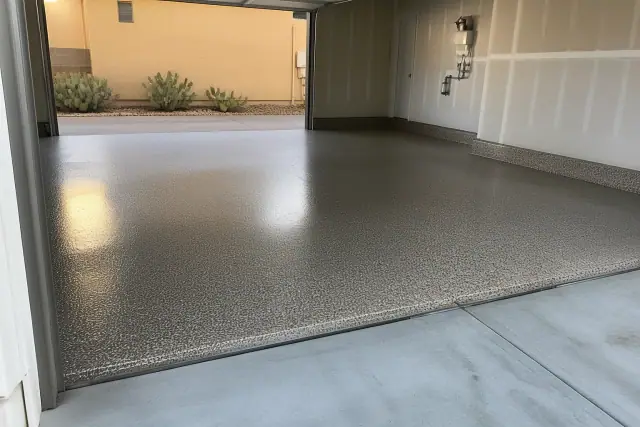
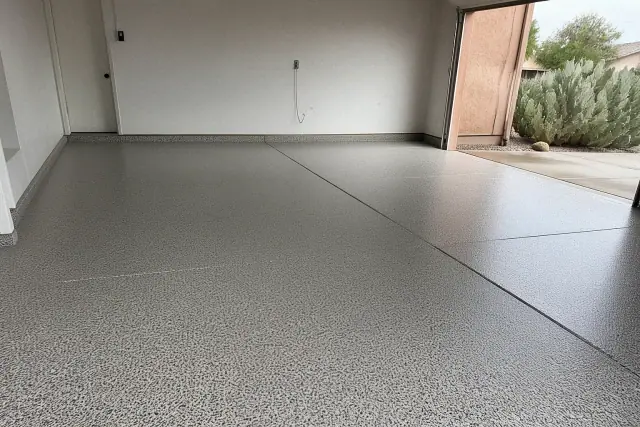
Empty two-car garage with a new decorative flake epoxy floor finish, viewed from inside in Tucson, AZ.

Flake Epoxy Flooring

Flake flooring broadcasts colored vinyl chips into a wet base coat before sealing them under a clear topcoat. The speckled, granite-like result hides dust, tire marks, and minor debris while adding useful texture underfoot.

  • Colored vinyl chip broadcast
  • Speckled, granite-like appearance
  • Better concealment of dust and tire marks
  • Added texture for everyday traction
  • Practical finish for busy residential garages
Request Estimate
Finding Your Right Fit

Choosing the Right Garage Floor Coating

The right coating depends on slab condition, moisture, sun exposure, traffic, chemical contact, finish preference, budget, and downtime. A full epoxy system may keep a garage closed for the better part of a week, while a polyaspartic or hybrid build can shorten the return-to-service window; an in-person slab inspection keeps that comparison grounded in the actual project.

Moisture-Tested Surface Preparation

We evaluate the slab, mechanically grind it with diamond-segmented tooling, repair damage, and check moisture with a calcium chloride or relative humidity meter. This preparation opens the concrete pores and identifies vapor conditions that can undermine adhesion.

Tucson Climate-Specific Materials

Our coating recommendations account for intense UV exposure, triple-digit summers, hot tires, cool winter nights, and monsoon humidity. UV-resistant, chemical-resistant, and anti-skid options are selected according to where and how the surface will be used.

Licensed and Insured Installation

Tucson Epoxy Co. is a licensed and insured flooring contractor, and our installers are trained in professional application methods. We follow manufacturer specifications for coating thickness, cure temperature, and humidity and stand behind our workmanship on residential and commercial projects.

What Sets Us Apart

Why Choose Tucson Epoxy Co. for Installation?

A floor coating performs only as well as the slab evaluation, preparation, resin selection, application, and cure schedule behind it. We explain those decisions clearly, provide a written estimate for the work, and recommend a system based on the floor's actual condition and intended use.

Request a Floor Quote

Cracks and Spalling

Seasonal movement in caliche-heavy soil can drive hairline cracks that widen, while unprotected surfaces may pit or spall. Those weak areas need repair before coating so the new system bonds to sound concrete.

Moisture Vapor

Slabs poured without a vapor barrier can hold moisture that pushes toward the surface. Testing before installation helps prevent bubbling, blistering, peeling, and delamination caused by trapped vapor beneath the coating.

Oil and Chemical Stains

Motor oil and workshop chemicals can soak into bare concrete and interfere with coating adhesion. Existing stains require degreasing and additional grinding, while the finished system can be specified to resist gasoline, brake fluid, solvents, and pool chemicals.

Hot Tire Pickup

Warm tires can soften and pull at a coating after highway driving in Tucson heat. Polyaspartic and hybrid systems offer greater hardness, flexibility, and resistance to the marks and lifting associated with hot tire pickup.

UV Yellowing and Monsoon Haze

Standard epoxy is more prone to UV yellowing under direct sun and to amine blush during Tucson's humid monsoon stretches in July and August. A UV-resistant polyaspartic topcoat is often the better exposed finish when a garage door remains open for hours.

Slippery Wet Surfaces

A smooth glossy coating can become slick after washing a car or when water reaches a patio or pool deck. Fine aluminum oxide or polymer grit broadcast into the final topcoat adds texture and makes a measurable difference in everyday traction.

How it works

Our Garage Floor Epoxy Process

A durable floor comes from disciplined preparation and controlled application. We move from slab inspection through grinding, repairs, coating, topcoat, and a written cure schedule so each stage supports the next.

01.

Inspect and Moisture-Test the Slab

We inspect the concrete for cracks, pitting, spalling, oil, old coatings, and access concerns, then measure moisture with a calcium chloride or relative humidity meter. The findings guide repairs, preparation, and resin selection.

02.

Mechanically Grind the Concrete

Diamond-segmented grinding removes sealers, weak surface material, and failed coatings while opening the concrete pores. We vacuum the floor clean so the primer can penetrate and bond to a sound surface.

03.

Repair Cracks and Spalled Areas

Cracks, pitting, and spalling are repaired with a polymer-modified patching compound before coating. Oil stains are degreased, and the floor is power washed when needed, then allowed to dry fully.

04.

Apply Primer and Base Coat

A concrete-penetrating primer goes down first, followed by the base epoxy at a controlled mil thickness with rollers and squeegees. Cure temperature and humidity stay within the selected manufacturer's application specifications.

05.

Build the Decorative Finish

Decorative flake is broadcast or metallic pigment is manipulated while the base remains workable. A clear epoxy, polyurethane, or polyaspartic topcoat then supplies the intended UV, chemical, stain, and traction properties.

06.

Inspect the Finish and Set Cure Times

We check coverage, texture, and color, then provide the project's cure schedule in writing. Standard epoxy generally needs 3 to 5 days before vehicle parking, while polyaspartic systems can often accept vehicle traffic within 24 to 48 hours.

Get Better Service

Schedule a Garage Floor
Coating
Consultation

Tell Tucson Epoxy Co. how you use the space, the finish you prefer, and when you need it back in service. We will inspect the slab and prepare a written estimate that accounts for surface preparation, materials, labor, repair needs, and coating design.

Garage Floor Coating Help

Garage Floor Epoxy FAQs

Compare costs, cure times, coating choices, preparation, finishes, and expected service life before planning your Tucson garage floor project.

Call Our Experts

Professionally installed garage floor epoxy in the Tucson market typically costs between $4 and $9 per square foot. The final amount depends on slab condition, preparation, coat count, and whether the finish uses solid color, decorative flake, metallic pigment, or a premium polyaspartic system.

A typical two-car garage of roughly 400 to 500 square feet generally costs $2,000 to $4,500 for a standard epoxy system. Premium polyaspartic systems with metallic or flake finishes can cost $4,500 to $7,000 for the same size, depending on slab condition, crack repair, and design complexity.

Standard epoxy can be slippery when wet without an anti-skid additive, and it is more vulnerable than polyaspartic to UV yellowing and monsoon-related amine blush. Skipping grinding or moisture testing can cause bubbling, peeling, or delamination within months or during the first year or two instead of delivering 10 or more years of service, and a full-cure epoxy installation also keeps vehicles off the floor for several days.

Polyaspartic coatings cure faster and resist UV fading, hot tire pickup, and chemical exposure better than standard epoxy, which makes them a strong Tucson option. A hybrid system can pair an epoxy base with a polyaspartic topcoat to balance cost and durability, but the right choice depends on budget, garage use, finish, and required turnaround.

A 20-by-20 garage is 400 square feet and generally falls in the $2,000 to $4,500 range for a standard epoxy system. Premium metallic pigment or heavy flake finishes can move the same footprint toward $3,000 to $5,000, with the exact amount set by the slab and preparation needs.

Standard epoxy typically needs about 24 hours before light foot traffic and 3 to 5 days before a vehicle is parked on it. Polyaspartic systems often allow foot traffic the same day and vehicle traffic within 24 to 48 hours, though temperature, humidity, and the specific product determine the written cure schedule.

A three-car garage generally measures 600 to 750 square feet. At $4 to $9 per square foot, a standard installation is roughly $3,000 to $6,500, while premium polyaspartic or metallic systems can reach $6,000 to $9,500 depending on design complexity and slab preparation.

The slab is mechanically ground with diamond-segmented tooling to remove sealers and weak material and open the concrete pores. Cracks, pitting, and spalling are patched, oil is degreased, and the floor is vacuumed clean and dried before a penetrating primer and base coat are applied.

Some Tucson slabs were poured without a vapor barrier, allowing trapped moisture to move toward the coating. A calcium chloride or relative humidity meter helps identify excess moisture before installation so the system can be planned around the actual slab conditions.

Options include solid colors, blended color schemes, flake broadcasts, and mica-based metallic pigments. Flake creates a speckled, granite-like finish that hides dirt and tire marks, while metallic epoxy forms custom three-dimensional marbled patterns.

Commercial systems can use higher-mil-thickness base coats and slip-resistant additives for showrooms, dealerships, offices, foot traffic, and rolling carts. Heavy-duty industrial systems can be formulated for forklifts, pallet jacks, oil, solvents, abrasion, and static-dissipative needs.

Yes, Tucson Epoxy Co. applies decorative concrete coating principles to patios and pool decks as well as garages. Outdoor surfaces benefit from UV-resistant finishes and an anti-skid additive because direct sun and splashed water create different exposure and traction needs.

A quality epoxy or polyaspartic system is engineered to last 10 to 20 years under normal residential use when installed over a properly prepared slab. Actual service life depends on preparation, moisture, resin quality, traffic, chemical exposure, UV exposure, and maintenance, which is generally limited to routine sweeping and occasional mopping.