Proudly serving Tucson, Oro Valley, Marana, Vail, Sahuarita, Green Valley & surrounding areasCall or Text 24/7: +1 (520) 567-9887

Concrete Repair, Resurfacing, and Slab Preparation Services in Tucson, AZ

Tucson Epoxy Co. repairs and resurfaces concrete for homes, garages, patios, pool decks, warehouses, and industrial spaces across Tucson, Arizona. Our services include crack repair, slab lifting and leveling, garage floor epoxy, commercial and industrial epoxy flooring, and protective outdoor coatings. We also install flake, metallic, and polyaspartic finishes selected for the way each surface is used. Every recommendation begins with the condition of the existing slab.

Tucson's expansive caliche and hardpan clay can shift when monsoon rain follows months of 100-plus degree heat. Thermal cycling between summer highs and winter nights in the 30s adds stress that shows up as cracking, spalling, and settlement. We diagnose active movement, moisture, and sub-base instability before resurfacing so the repair addresses the cause instead of hiding a symptom. Mechanical profiling and properly matched repair materials help the new surface bond and endure local conditions.

Our crews follow surface-preparation guidance consistent with International Concrete Repair Institute profile standards and American Concrete Institute guidelines. Tucson Epoxy Co. holds Arizona Registrar of Contractors licensing and complies with Arizona Department of Environmental Quality low-VOC coating requirements on every job. After inspecting the slab, we provide a written estimate based on its condition, size, moisture results, and required repair work.

Tucson Epoxy Co. provides concrete repair and resurfacing throughout Tucson and the surrounding metro area, including Oro Valley, Marana, Sahuarita, Vail, Green Valley, and Rita Ranch.

★ ★ ★ ★ ★4.9/5 Average Rating · 20+ Years of Experience · Thousands of Customers Helped · Licensed & Insured · Residential & Commercial

Concrete Repair & Resurfacing Options

What Does Concrete Repair & Resurfacing Include?

Concrete repair and resurfacing renews an existing slab when it remains a suitable base. We inspect for active cracking, moisture, settlement, spalling, and sub-base failure, then determine whether the surface needs targeted repair, a bonded overlay, a full skim coat, or a protective coating.

Active cracks may be routed and sealed with polyurethane or epoxy injection resin. When a structurally sound slab has settled or tilted, polyurethane foam injection or mudjacking can raise it back to grade before resurfacing and help restore drainage away from foundations.

Spalled or pitted areas are ground back to sound concrete, rebuilt with repair mortar, and prepared with a bonding agent. The finished system is then matched to traffic, chemical exposure, sunlight, slip-resistance needs, and the desired appearance.

Benefits of Professional Concrete Resurfacing

When the underlying slab is sound, resurfacing can restore appearance and performance at a fraction of full replacement cost. Professional concrete resurfacing commonly lasts 8 to 15 years depending on the material system, traffic load, exposure, and maintenance.

  • Repairs cracks before they can telegraph through a new finish
  • Re-levels suitable sunken sections without full demolition
  • Restores drainage slope away from nearby foundations
  • Rebuilds flaking, pitted, or exposed-aggregate surfaces
  • Seals against oil, brake fluid, tire residue, and staining
  • Adds abrasion resistance for vehicle, foot, and rolling traffic
  • Uses UV-stable options for patios and pool decks
  • Offers slip-resistant, flake, metallic, and clear-finish choices
Concrete Restoration Services

Concrete Repair & Resurfacing Services

The right repair depends on why the concrete failed and how the finished surface must perform. We combine structural and surface work as needed, from crack injection and slab lifting to residential, commercial, decorative, and outdoor coating systems.

Crack Repair & Resurfacing

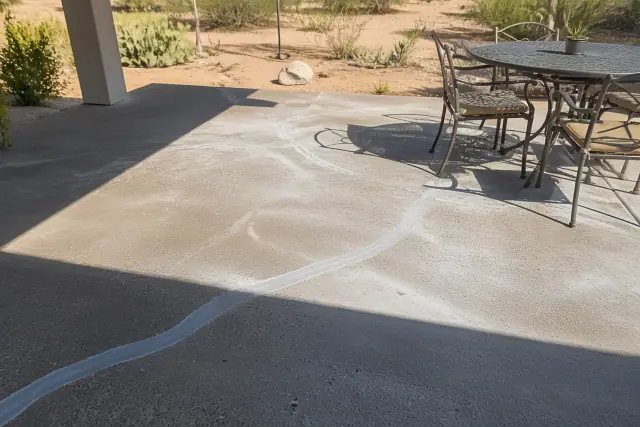
Concrete backyard patio undergoing crack repair and surface leveling in Tucson, AZ.

We route and seal active cracks with polyurethane or epoxy injection resin, stabilize the supporting conditions when needed, and resurface only after the repair is ready. This sequence helps prevent a moving crack from showing through the new surface within a year.

Request Estimate

Concrete Lifting & Leveling

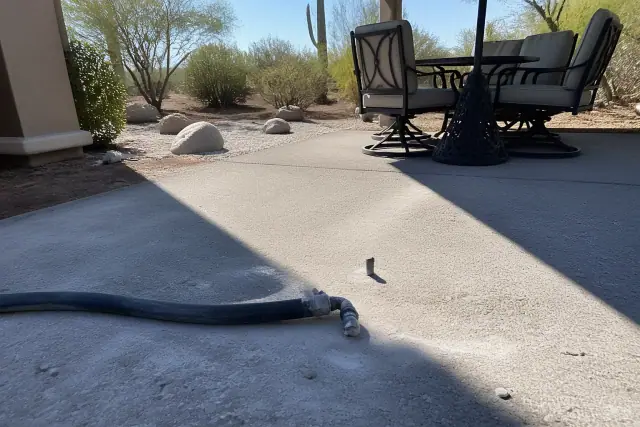
Concrete leveling and repair work on a backyard patio in Tucson, AZ, featuring an injection port and mud-jacking hose.

For a structurally sound slab that has settled or tilted, we can inject expanding polyurethane foam or a cementitious slurry through small access holes. Filling the void and raising the section back to grade addresses the underlying settlement before a finish is installed.

Request Estimate

Garage Floor Epoxy

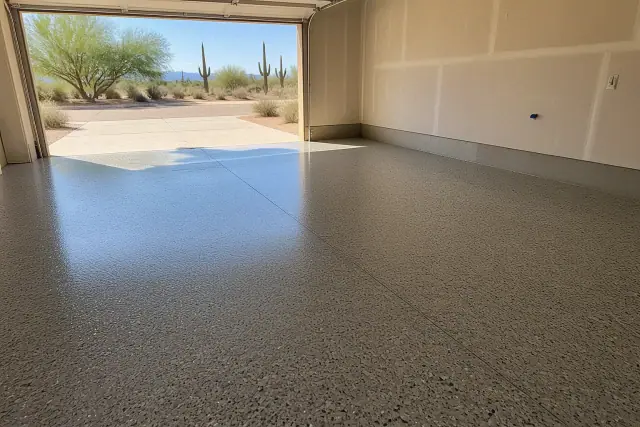
Epoxy base coat with decorative flakes on a prepped garage floor in Tucson, AZ, with cacti visible outside.

Garage floor resurfacing starts with diamond grinding, crack and pit repair, and a moisture-mitigating primer. A 100% solids epoxy base coat, optional color flake broadcast, and clear topcoat create a bonded surface that resists abrasion, automotive fluids, and hot-tire pickup.

Request Estimate

Commercial & Industrial Flooring

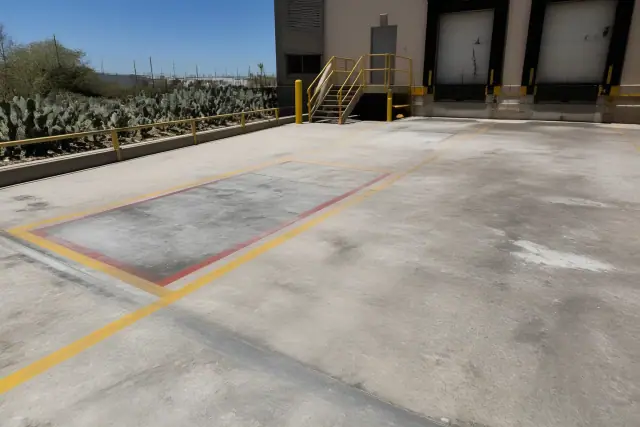
Industrial concrete warehouse floor with safety markings at a loading dock in Tucson, AZ.

High-build epoxy and polyaspartic floors can be configured for warehouses, manufacturing spaces, showrooms, and retail areas. We account for pallet jacks, forklifts, rolling loads, foot traffic, and operation-specific chemical exposure when selecting build thickness, resin, and slip-resistant aggregate.

Request Estimate

Patio & Pool Deck Coatings

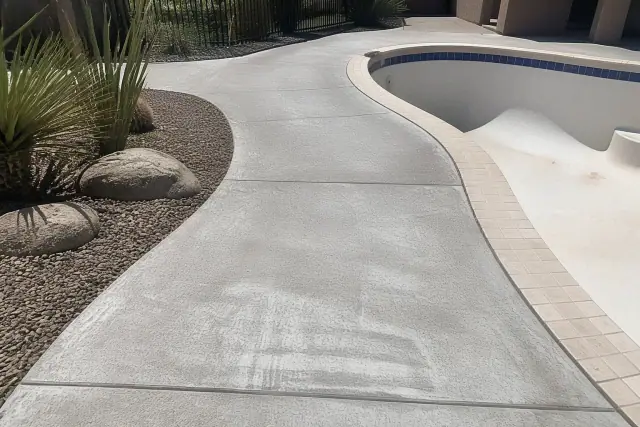
Drained swimming pool and concrete walkway prepared for resurfacing in Tucson, AZ.

Outdoor coatings must handle intense sun, monsoon runoff, irrigation minerals, pool chemicals, and wet foot traffic. We use weather-resistant epoxy or polyaspartic options with UV-stable pigments and textured, slip-resistant finishes appropriate for patios and pool decks.

Request Estimate

Decorative Metallic & Flake Epoxy

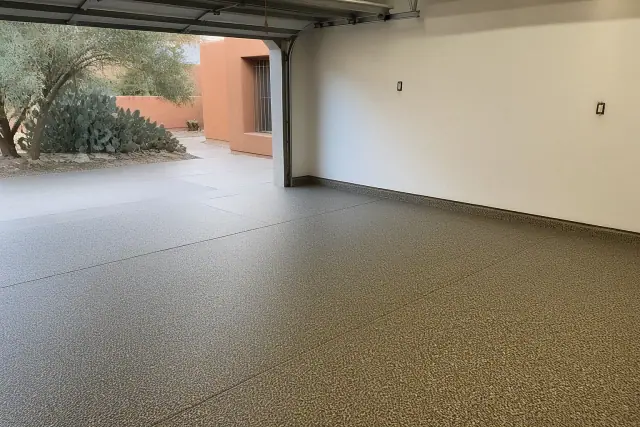
Empty two-car garage with a finished decorative flake epoxy floor in Tucson, AZ.

Decorative resurfacing adds design without giving up a sealed, protective finish. Vinyl flake can disguise minor surface variation and improve traction, while metallic pigments create distinctive marbled movement for showrooms, tasting rooms, commercial spaces, and custom homes.

Request Estimate
Material & Finish Options

Concrete Resurfacing Options

Overlay and coating materials perform differently under sunlight, chemicals, vehicle traffic, and scheduling constraints. We match the finish to the prepared slab and the property's actual use rather than treating every surface as the same.

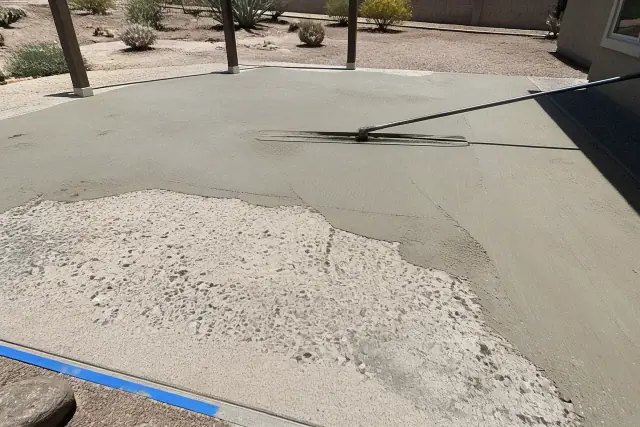
Concrete patio repair with leveling screed marks on an outdoor pad in Tucson, AZ.

Bonded Overlays & Skim Coats

A bonded overlay or skim coat can renew worn concrete when the original slab is structurally sound and stable. Mechanical profiling, crack repair, and a bonding agent are essential because an overlay cannot correct ongoing structural movement by itself.

  • Full skim coats for broadly worn surfaces
  • Targeted build-back with exterior-rated repair mortar
  • Bonded placement over mechanically opened concrete
  • Suitable for interior or exterior renewal when conditions allow
  • Avoids unnecessary removal of a serviceable slab
Request Estimate
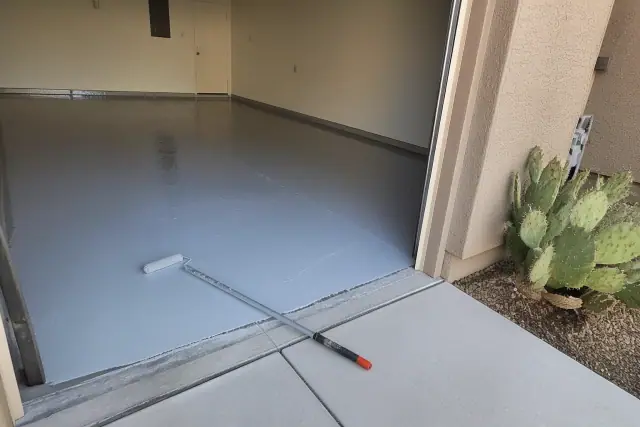
Wet epoxy coating being applied to a residential garage concrete floor in Tucson, AZ.

100% Solids Epoxy

Epoxy provides build thickness, chemical resistance, and abrasion resistance for residential garages and demanding commercial or industrial floors. The system bonds to properly profiled concrete and can carry decorative or slip-resistant broadcast materials.

  • Moisture-mitigating primer when testing calls for it
  • 100% solids epoxy base coat
  • Resistance to oil, brake fluid, and tire residue
  • High-build options for rolling and forklift traffic
  • Clear protective topcoat over the selected finish
Request Estimate
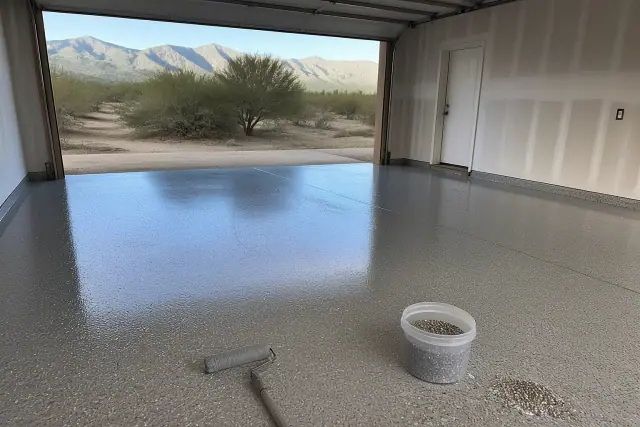
Freshly applied polyaspartic coating on a concrete garage floor in Tucson, AZ, with a paint roller and color flakes.

Polyaspartic Coatings

Polyaspartic coatings cure faster than standard epoxy and offer better UV stability and flexibility across wider temperature swings. Some systems allow return to service in as little as 24 hours rather than the several days often required for epoxy.

  • Fast-cure option for shorter shutdowns
  • Improved resistance to UV yellowing
  • Well suited to patios and pool decks
  • Flexible performance across temperature swings
  • Available with clear or broadcast finishes
Request Estimate
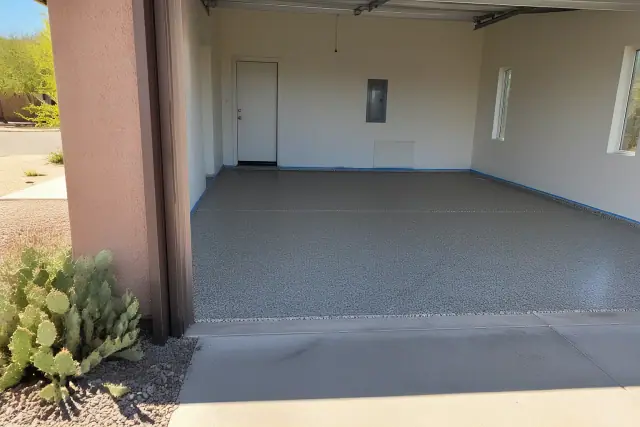
Freshly applied epoxy flake floor in a residential garage in Tucson, AZ, with masking tape visible on the stem walls.

Flake Epoxy Finishes

Colored vinyl chips are broadcast into a wet epoxy base and sealed beneath a clear topcoat. The layered finish brings texture and visual variation to garages, patios, commercial lobbies, and other heavily used surfaces.

  • Helps hide minor surface imperfections
  • Adds texture for improved slip resistance
  • Offers coordinated color combinations
  • Handles heavy foot traffic when properly specified
  • Seals the broadcast beneath a clear topcoat
Request Estimate
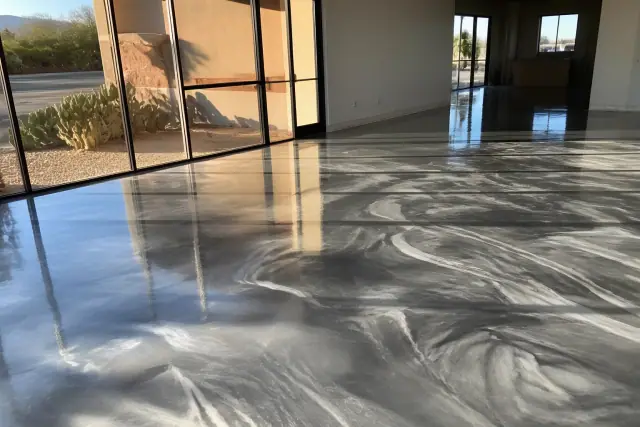
Wet metallic epoxy finish applied to a concrete floor in a Tucson, AZ retail showroom with desert sunlight.

Metallic Epoxy Finishes

Metallic epoxy suspends pigment powders in clear resin and uses controlled tool work and airflow to form three-dimensional marbled patterns. Because the material moves during installation, no two completed metallic floors look identical.

  • Distinctive marbled visual movement
  • Popular for showrooms and tasting rooms
  • Suited to high-end residential spaces
  • Combines decorative depth with a sealed surface
  • Customized through pigment and application technique
Request Estimate
Finding the Right Fit

Choosing the Right Concrete Resurfacing Approach

We choose a repair method only after evaluating slab stability, moisture, crack activity, surface loss, traffic, chemical exposure, sunlight, and the required return-to-service window. A sound but settled slab may need lifting; a stable worn slab may accept an overlay; and a garage, patio, pool deck, warehouse, or processing floor may require a coating engineered for its particular exposure. If the base is too unstable for resurfacing, we explain that before recommending a finish and provide a written estimate after inspection.

Diagnosis Before Resurfacing

We test for moisture vapor emission, identify active cracks, and assess the sub-base before selecting a system. That up-front diagnosis distinguishes a surface defect from settlement or structural movement that must be corrected first.

Mechanical Surface Preparation

Diamond grinding, shot blasting, and mechanical profiling open the concrete and remove weak material more reliably than acid etching alone. For commercial work, we prepare to ICRI surface profiles from CSP 3 to CSP 5 as the specified coating requires and manage dust with vacuum-shrouded equipment.

Arizona Licensing & Low-VOC Compliance

Tucson Epoxy Co. holds Arizona Registrar of Contractors licensing. Our work also complies with Arizona Department of Environmental Quality low-VOC coating requirements on every job while following relevant ICRI and ACI surface guidance.

What Sets Us Apart

Why Tucson Concrete Needs a Tailored Approach

A coating placed over an active crack or unstable sub-base can fail within a season. We connect the repair method to the slab's actual damage, then select the overlay, epoxy, polyaspartic, flake, metallic, or textured finish around the property's traffic and exposure. Request an on-site inspection to learn which path fits your concrete.

Request a Slab Inspection

Cracks from Soil Movement

Tucson's shrink-swell clay moves seasonally, and monsoon water beneath a slab can cause hairline cracks to widen. We evaluate whether routing and sealing is enough or whether the sub-grade must also be stabilized.

Uneven or Sunken Slabs

Poor original compaction or erosion can leave concrete settled or tilted, including slabs in Rita Ranch and older neighborhoods near downtown. Lifting suitable sections before resurfacing can restore grade and improve drainage away from foundations.

Spalling, Pitting & Exposed Aggregate

Moisture intrusion and UV exposure can leave a slab flaking, pitted, or worn down to visible aggregate. Deteriorated material must be removed to sound concrete before a bonding agent and exterior-rated repair mortar rebuild the profile.

Scaling from Sun & Weather

Tucson's intense UV exposure and rapid heat-to-monsoon swings can scale unsealed concrete even without freeze-thaw cycling. A UV-resistant topcoat protects the restored surface instead of simply masking the damage.

Garage Dust, Stains & Hot Tires

Bare garage concrete absorbs oil, brake fluid, and tire residue while dusting and pitting under heat. A properly bonded epoxy membrane resists those automotive fluids, abrasion, and the hot-tire pickup that can damage poorly installed coatings.

Moisture & Coating Delamination

Moisture vapor and inadequate surface profiling can prevent a coating from bonding, especially under rolling loads. Testing, sound-concrete preparation, and the correct primer reduce the risk of delamination within months.

How It Works

Our Concrete Resurfacing Process

Each project moves from diagnosis to preparation, repair, coating, and a clear cure-time handoff. The sequence may change when a slab must be lifted first, but every installed finish depends on a stable, clean, mechanically profiled surface.

01.

Inspect & Moisture-Test

We inspect the slab on site, test for moisture vapor emission, identify active cracking, and assess the supporting base. These findings determine whether repair, lifting, an overlay, or a coating is appropriate.

02.

Grind or Shot Blast

We use diamond grinding, shot blasting, or other mechanical profiling to open the concrete and remove weak surface material. Vacuum-shrouded grinding equipment helps contain and manage dust in the work area.

03.

Repair Cracks & Spalls

Cracks are routed and sealed, pitted or spalled areas are rebuilt, and suitable sunken sections are lifted before resurfacing. The repair materials are matched to the damage and the surface exposure.

04.

Prime the Prepared Slab

A compatible primer is applied to the sound, profiled concrete, with moisture mitigation included when test results require it. This bond layer prepares the slab for the selected overlay or coating.

05.

Install the Finish

We install the base coat or overlay and add the specified flake, metallic pigment, or slip-resistant aggregate. Commercial floors may use high-build resin selected for rolling loads or operation-specific chemicals.

06.

Topcoat & Review Cure Times

A clear or UV-stable protective topcoat completes the system where specified. We explain separate wait periods for foot traffic, vehicles, and chemical exposure before leaving the project.

Restore Your Concrete

Plan Your Concrete Repair & Resurfacing Project

Start with an on-site slab inspection and a written estimate. We will evaluate the damage, moisture, sub-base, traffic, sunlight, and finish goals, then explain whether repair, lifting, an overlay, epoxy, or polyaspartic coating is the appropriate next step.

Concrete Service Help

Concrete Repair & Resurfacing FAQs

Get practical answers about cost, slab condition, coating choices, preparation, service life, and project timing for concrete repair and resurfacing in Tucson.

Call About Your Concrete

Standard broadcast or overlay systems typically run $3 to $10 per square foot, while decorative metallic or multi-color flake work typically runs $6 to $20 per square foot. Smaller residential jobs often fall between roughly $1,200 and $1,800 total, with larger driveways, patios, and commercial floors scaling according to size and preparation needs. Tucson Epoxy Co. inspects the slab and provides a firm written quote rather than a rough phone estimate.

In most cases, cracked, pitted, spalled, or sun-faded concrete can be resurfaced if the slab remains a sound base. Active structural movement, severe sub-base failure, or full-depth cracks may require structural repair or lifting first. We inspect the condition and moisture before recommending a finish.

Standard concrete resurfacing typically lasts 8 to 15 years, and properly installed epoxy or polyaspartic systems can perform beyond that with routine maintenance. Service life depends on the selected material, traffic, UV exposure, cleaning, and resealing needs. An indoor garage and a sun- and chlorine-exposed pool deck will not age at the same rate.

Yes, when the old slab is structurally sound, thoroughly cleaned, and mechanically profiled. Cracks should be repaired and a bonding agent applied before the skim coat. Skipping preparation is a common reason a skim coat can delaminate within a year.

The 4-2-1 rule is a general base-layer guideline sometimes described as roughly 4 inches of compacted gravel, 2 inches of sand bedding, and 1 inch of leveling material in certain overlay applications. Exact specifications vary by project and engineer, and the guideline relates more to slab construction and sub-base preparation than resurfacing. For an existing slab, we assess the base that is actually present.

An overlay depends on the existing slab, so active cracks or an unstable base can transfer damage back to the surface within a season or two. Installation quality is critical, and inadequate profiling is a leading cause of early failure. An overlay may not last as long as a new poured slab, but it can reduce cost and project time when the base is suitable.

Most residential garage epoxy projects take one to two days from preparation through the final topcoat. Light foot traffic is often possible within 24 hours, while full vehicle traffic typically requires three to five days depending on the system. Polyaspartic materials can cure faster, so we provide the exact schedule selected for the project.

Epoxy offers strong chemical resistance and build thickness for garages and industrial settings. Polyaspartic offers faster turnaround, better UV stability, and flexibility across wider temperature swings, which can suit patios and pool decks. The better choice depends on traffic, sun, chemical exposure, and the required timeline.

Yes, if the slab is structurally sound but settled or tilted. Small access holes allow expanding polyurethane foam or a cementitious slurry to fill voids and raise the section back to grade. Injection typically takes hours rather than days, and the slab can usually bear weight again within an hour.

Preparation starts with moisture testing and damage assessment, followed by diamond grinding, shot blasting, or mechanical profiling rather than acid etching alone. We repair cracks and spalls, remove deteriorated material to sound concrete, and apply the required bonding agent or primer. Commercial coating specifications may call for an ICRI profile from CSP 3 to CSP 5.

Outdoor concrete needs a weather-resistant, UV-stable system rather than a standard interior coating. Polyaspartic or UV-stable epoxy topcoats can resist yellowing, monsoon staining, irrigation minerals, chlorine, and sunscreen exposure. Pool decks also receive textured, slip-resistant finishes for wet barefoot traffic.

High-build epoxy or polyaspartic systems can be designed for forklifts, pallet jacks, steel racking, rolling loads, and constant foot traffic. Slip-resistant aggregate improves traction, while resin selection reflects the actual chemicals present. Novolac epoxy may suit aggressive solvents, acids, or caustics, while standard epoxy can serve general industrial use.

Tucson Epoxy Co. serves Tucson and the surrounding metro area, including Oro Valley, Marana, Sahuarita, Vail, Green Valley, and Rita Ranch. Service recommendations are based on the slab and exposure at each property.