Residential and Commercial Lifespans
Normal residential use supports the longest service window. Forklifts, pallet jacks, repeated vehicle traffic, and impacts push commercial floors toward earlier recoating.
Tucson Epoxy Co. installs polyaspartic systems on garages, patios, pool decks, and commercial floors across Pima County. A properly installed coating typically lasts 15 to 25 years, while a lightly used residential garage can exceed 30 years before recoating. Tucson heat, UV exposure, dust, and monsoon humidity make preparation, cure conditions, and maintenance especially important to reaching that range.
Normal residential use supports the longest service window. Forklifts, pallet jacks, repeated vehicle traffic, and impacts push commercial floors toward earlier recoating.
A mechanically prepared ICRI CSP 3 surface, cracks and spalls repaired with polymer-modified mortar, moisture-vapor testing, and the proper coating thickness help prevent early delamination.
Remove dust and grit weekly, mop monthly with a pH-neutral cleaner, and blot oil, coolant, or pool-chemical spills promptly. Felt pads under jack stands and quick chip repairs also protect the finish.
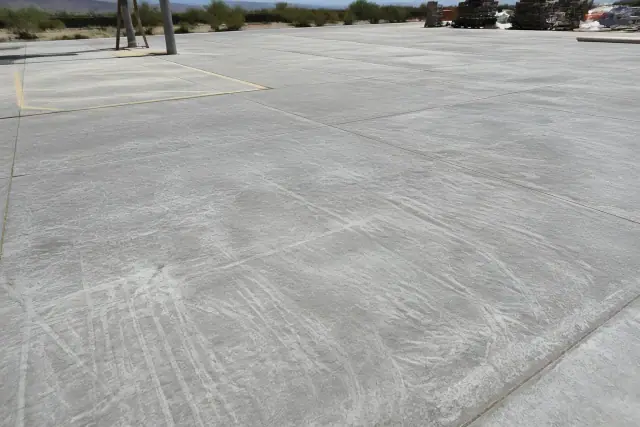
The open, even concrete profile produced by mechanical grinding, along with repaired cracks and spalls. This preparation gives the coating a sound surface to bond to.
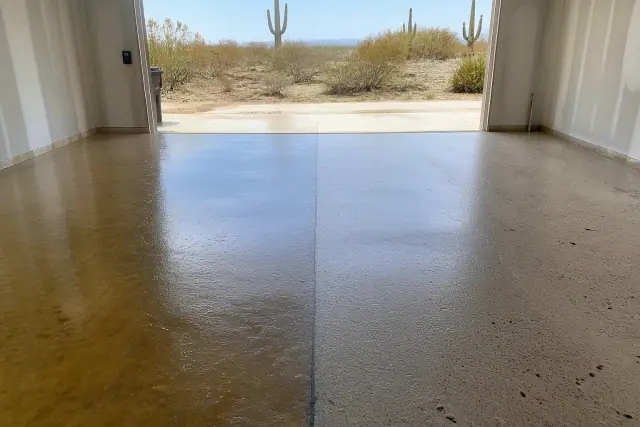
Compare amber yellowing, fine traffic scratches, and hot-tire lifting on epoxy with the color retention of an aliphatic polyaspartic surface under the same sunlight.
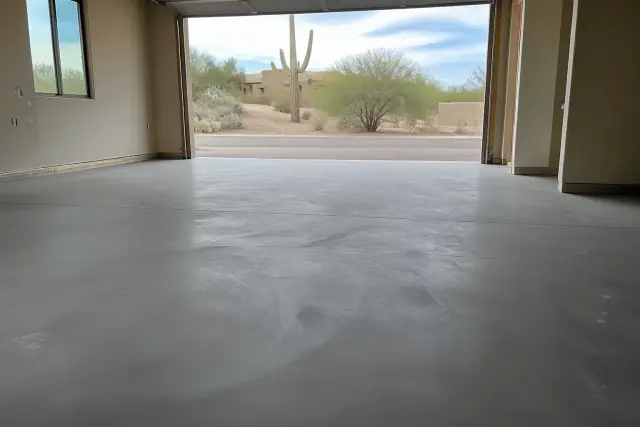
A worn but firmly bonded finish being lightly abraded and cleaned for a fresh topcoat. Peeling or delaminated areas instead require removal back to sound concrete.
A residential garage can reach the 20-year mark with family vehicles, occasional oil drips, and seasonal cleaning. Some remain serviceable past 25 years and receive a new topcoat mainly for appearance.
Summer slab surfaces can rise well above 140°F, while monsoon humidity can jump from single digits to over 50% within hours. Cure timing and moisture control must account for both extremes.
A patio with a UV-stable topcoat and proper drainage can provide 15-20 years of service. Textured pool decks commonly reach 10-15 years before recoating because chlorine, sunscreen, and wet-dry cycling add wear. Covered patios in Sam Hughes and the Catalina Foothills also benefit from standing-water resistance when summer storms drop an inch of rain in under an hour.
Skipping diamond grinding or reducing coating thickness can shrink service life to 5-7 years. Acid-etch-only preparation can lead to delamination within the first year, while a rushed application in summer heat can peel within months.
| Coating or Setting | Typical Service Window | Primary Wear Factor |
|---|---|---|
| Standard epoxy | 5-10 years | UV yellowing and hot-tire lifting |
| High-solids epoxy | 8-12 years | Moderate UV stability |
| Residential polyaspartic | 15-25 years | Preparation, traffic, and maintenance |
| Light-use polyaspartic garage | Past 30 years is possible | Low traffic and regular cleaning |
| Commercial polyaspartic | 10-15 years | Forklift and pallet-jack traffic |
| Outdoor polyaspartic patio | 15-20 years | UV exposure, drainage, and thermal cycling |
| Polyaspartic pool deck | 10-15 years | Chlorine and wet-dry cycling |
| Polyurea | 20-25 years | Use and installation conditions |
Polyaspartic is an aliphatic polyurea hybrid whose cross-linked film resists the UV yellowing associated with aromatic coatings. The lifespan range is not a fixed expiration date: a bonded floor may only need spot repairs or a fresh topcoat when gloss fades, while delamination calls for removal to sound concrete. Small chips can be repaired with matching resin, although color and sheen may vary slightly on flake or metallic finishes.
Surface preparation is the largest variable, followed by coating thickness and cure conditions. ASTM D4060 abrasion testing, ASTM D4541 adhesion testing, and ICRI CSP 2-4 surface-profile guidance provide useful durability benchmarks; a CSP 3 profile is appropriate for the preparation described here. Those benchmarks help distinguish a system intended for 20-25-year durability from a poorly bonded coating that can fail within a couple of years. After installation, forklift traffic, dropped tools, standing water, chlorine, sunscreen, dust, monsoon grit, and de-icing salts near Mount Lemmon can accelerate wear, while soft cleaning tools and prompt repairs help extend it.
What does a long-lasting system cost? Professional polyaspartic installation generally runs $6-$12 per square foot, compared with $3-$7 for basic epoxy, so a roughly 400-500-square-foot two-car garage may total $2,400-$6,000 depending on slab repairs and finish choices. That higher upfront cost may carry different value for someone selling within a year or two than for someone planning to use a 20-25-year floor. Can a worn floor be recoated? A well-bonded surface can be abraded, cleaned, and topped again for typically less than half the cost of full removal, potentially adding another 10-15 years. How soon can the floor return to use? Same-day fast-cure systems can be ready within 24-48 hours instead of a week, although they may carry a modest premium. Do warranties prove lifespan? Many professional installations carry 10-15-year terms and some market coverage is described as lifetime, but material, labor, impact, and moisture exclusions still need to be read carefully.
Share whether the floor is in a garage, patio, pool area, or commercial space, along with its traffic, age, finish, and visible damage. A local coating team can assess bond condition, moisture, and preparation needs before recommending maintenance, recoating, or replacement.