Polyaspartic for Sun and Speed
Choose polyaspartic when UV stability, impact resistance, and a short return-to-service window matter most, especially on sun-exposed garages, patios, and pool decks.
For Tucson garages, Tucson Epoxy Co. recommends choosing by slab moisture, sun exposure, cure window, and budget rather than treating one coating as universally better. Polyaspartic leads on UV stability, abrasion resistance, and fast return to service, while epoxy offers a lower installed cost and better tolerance of moisture vapor from the slab. A hybrid 100% solids epoxy basecoat with a polyaspartic topcoat combines those strengths for many garages, patios, and pool decks.
Choose polyaspartic when UV stability, impact resistance, and a short return-to-service window matter most, especially on sun-exposed garages, patios, and pool decks.
Choose epoxy when installed cost or moisture vapor from an older slab is the main concern. A 100% solids formulation also creates a thick, durable base for flake or metallic finishes.
For many Tucson floors, an epoxy basecoat beneath a polyaspartic topcoat is the balanced choice: the lower layer bonds to the concrete and manages moisture while the upper layer resists sun and wear.
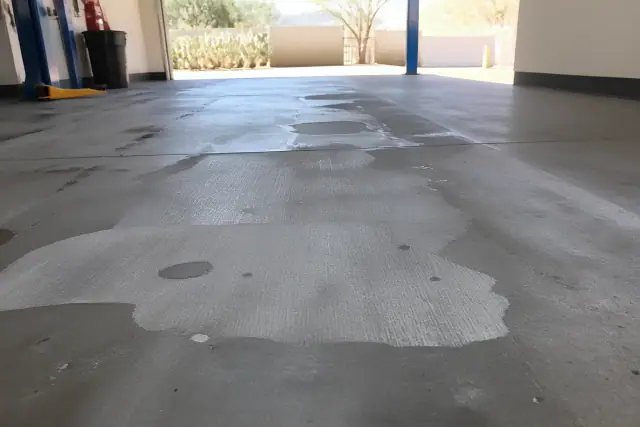
A clean, mechanically prepared slab with repaired cracks and an ICRI CSP 3-5 profile. Proper preparation gives either coating a sound surface for adhesion.
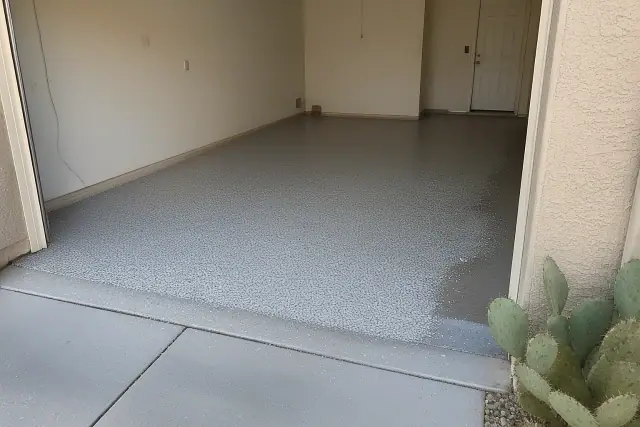
The epoxy layer bonding to prepared concrete with flake or quartz media broadcast evenly across the wet basecoat. This layer provides adhesion, build, and decorative flexibility.
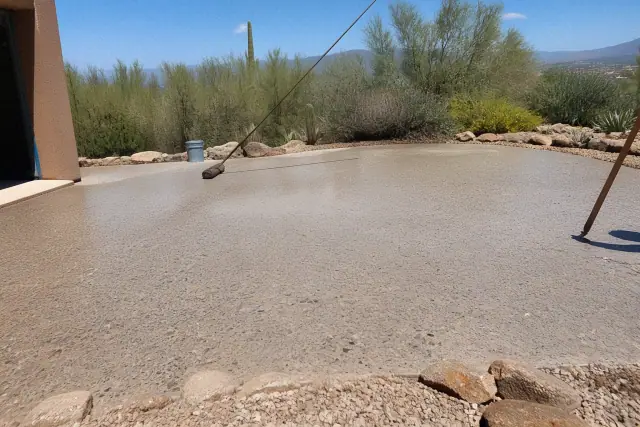
A clear polyaspartic topcoat protecting a bright, sun-exposed garage edge, patio, or pool deck. This image helps make UV stability and abrasion protection easy to understand.
Polyaspartic typically allows foot traffic in 4-6 hours, vehicle traffic in 24 hours, and reaches full chemical cure within a few days. Epoxy generally needs 24 hours for light foot traffic, 3 days for vehicles, and 5-7 days for full cure.
Epoxy installation generally runs $3-$7 per square foot. Polyaspartic typically runs $4-$12 per square foot, or roughly $7-$9 for a full two-part system, with most Tucson two-car garages totaling $2,000-$6,900 depending on preparation, repairs, and finish choices.
A properly installed polyaspartic system typically lasts 15-20 years, while standard epoxy lasts around 10-20 years depending on traffic, UV exposure, and topcoat protection. Sweep and use a pH-neutral cleaner; heavily used epoxy floors may need a new topcoat every few years.
Do not coat an untested, poorly prepared slab. Diamond grinding or shot blasting, crack and control-joint repair, thorough cleaning, and moisture testing are essential because contamination or trapped vapor can undermine either system.
| Decision Factor | Polyaspartic | Epoxy | Hybrid System |
|---|---|---|---|
| Sun exposure | UV stable | Can amber without a UV-stable topcoat | Polyaspartic topcoat protects the finish |
| Return to service | Fastest | Requires several days | Depends on each layer's recoat window |
| Slab moisture | Less forgiving during application | Handles higher moisture vapor loads | Epoxy base manages adhesion and moisture |
| Installed cost | Higher | Lower | Balances basecoat performance and topcoat durability |
| Best fit | Sun, abrasion, and limited downtime | Budget and moisture-sensitive slabs | Most Tucson garages, patios, and pool decks |
Neither material wins every comparison. Polyaspartic is better for UV exposure, abrasion, flexibility, and a fast cure; epoxy is better for lower cost and slabs with greater moisture vapor. For many Tucson garages, patios, and pool decks, an epoxy base with a polyaspartic topcoat provides the strongest balance.
Slab age, calcium chloride or relative humidity probe results, direct sun, repair needs, control-joint condition, and residential or commercial traffic all shift the recommendation. A shaded garage in Vail or Marana behaves differently from a west-facing patio in the Catalina Foothills, while older slabs near downtown Tucson or the Rincon area may need more moisture management. Polyaspartic is ideally applied at 55-95 degrees Fahrenheit with low humidity, epoxy at 60-90 degrees Fahrenheit away from direct sun, and Tucson slab temperatures can swing more than 60 degrees between a July afternoon and a January night.
Yes, polyaspartic can be installed over a properly prepared 100% solids epoxy basecoat, which is the preferred hybrid arrangement described in this guide. Polyaspartic is a type of aliphatic polyurea with slower reactivity than pure polyurea, which can cure in minutes. DIY epoxy offers a longer working window, but fast-curing polyaspartic can leave lap lines or patchy coverage when mixing and timing are inconsistent. Either choice still depends on grinding, cleaning, concrete repair, and moisture testing before coating.
Share your slab condition, moisture concerns, sun exposure, finish preferences, and required downtime. An inspection and moisture test can clarify whether epoxy, polyaspartic, or a hybrid system fits the floor before a firm quote is prepared.